Is a Perfect 5-Star Rating Bad for Business? What Buyers Really Trust
A spotless 5.0 feels like the goal, but buyers often trust a 4.6 more. What the research says about the "too good to be true" effect, the ratings customers actually filter by, and what to aim for instead.
On this page
- What does the research say about "too perfect"?
- What ratings do customers filter by?
- Why do a few critical reviews help?
- Should you worry if you have a perfect 5.0?
- What if your rating is below 4?
- How do you read your own rating like a customer?
- How should you show your rating on your website?
- The bottom line
Key takeaways
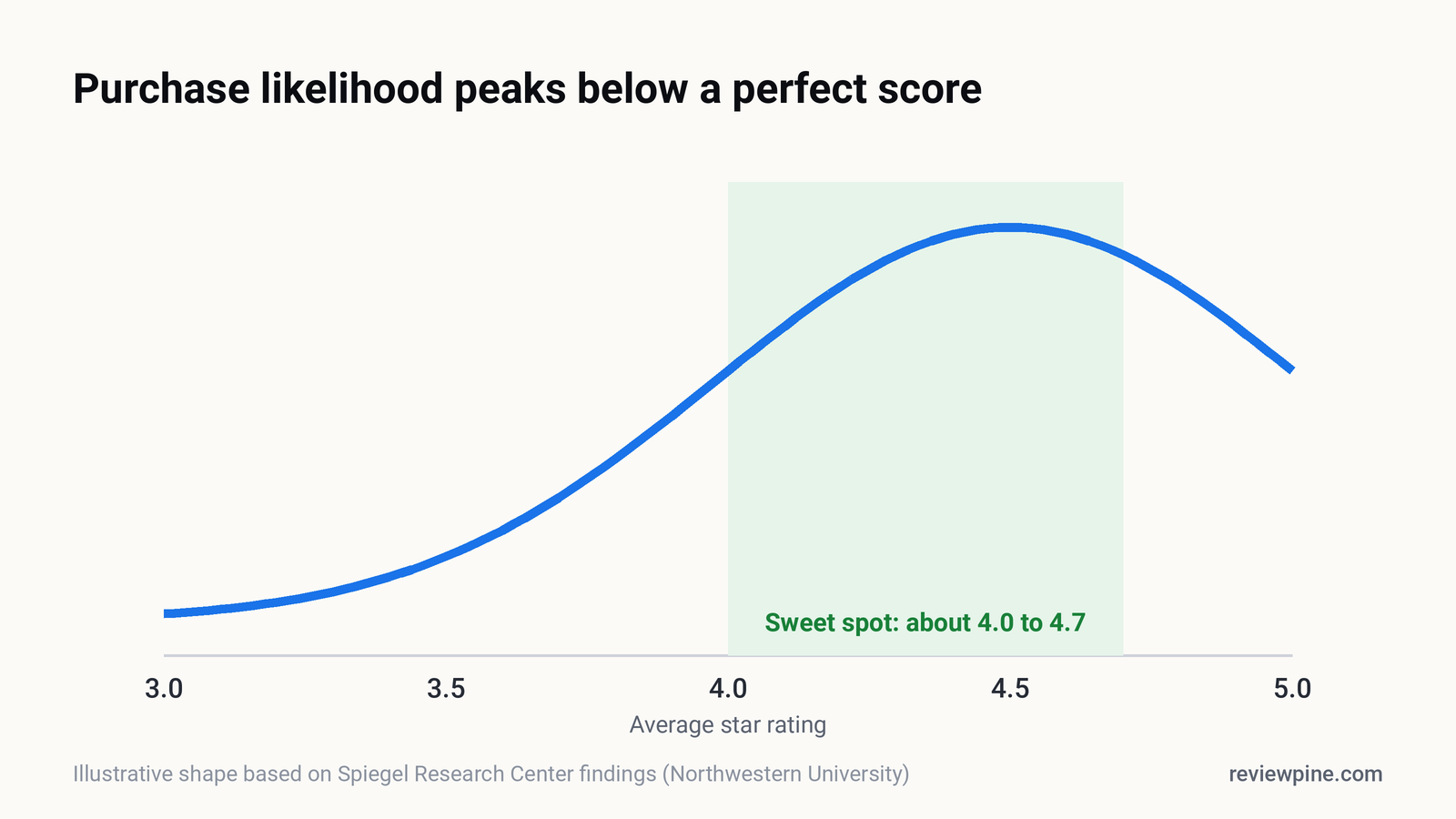
- Purchase likelihood peaks for ratings between about 4.0 and 4.7 and falls towards a perfect 5.0 (Spiegel Research Center).
- Only 10% of consumers will only use 5-star businesses; 31% require 4.5 stars and 68% require 4 stars (BrightLocal, 2026).
- Reviews feel most trustworthy when backed by other reviews with similar sentiment (56%).
- A few critical reviews, answered well, prove the positive ones are real.
- Aim to stay comfortably above 4.5 with many recent reviews rather than chasing perfection.
A perfect 5-star rating isn't bad in itself, but it often converts less than a slightly lower one. Northwestern's Spiegel Research Center found purchase likelihood peaks for average ratings between about 4.0 and 4.7, then falls as ratings approach a flawless 5.0, because buyers start to suspect the reviews are filtered or fake. What most customers want is a high rating that's clearly real: lots of recent reviews, mostly very positive, with a few honest criticisms answered well.
That doesn't mean you should want bad reviews. It means you can stop fearing the occasional one, and focus on what actually earns trust.
What does the research say about "too perfect"?#
The Spiegel Research Center's study of millions of shopping sessions found:
- purchase likelihood rose with ratings up to roughly 4.0 to 4.7;
- above that, it declined as ratings neared 5.0;
- reviews from verified buyers averaged 4.34 stars, compared with 3.89 from anonymous reviewers.
The explanation is intuitive. Real customer bases contain a range of experiences. A business with hundreds of reviews and not a single critical one invites the question: what happened to the unhappy customers?
What ratings do customers filter by?#
Ratings still matter enormously; they just don't need to be perfect. BrightLocal's 2026 survey found 92% of consumers say star ratings factor into their decision. The thresholds they use:
| Minimum rating required | Share of consumers (2026) | Change from 2025 |
|---|---|---|
| 5 stars only | 10% | Small minority |
| 4.5 stars or more | 31% | Up from 17% |
| 4 stars or more | 68% | Up from 55% |
So the practical target isn't 5.0. It's staying comfortably above 4.5, where you pass almost everyone's filter, while keeping a profile that looks like real life.
Why do a few critical reviews help?#
They prove the positive ones are real#
BrightLocal found the single biggest factor that makes a review trustworthy is that it's "backed up by other reviews with similar sentiment" (56%). A realistic spread, mostly positive, a few mixed, reads as a genuine pattern.
They show how you handle problems#
A three-star review with a calm, specific reply often persuades more than another five-star review, because it answers the question buyers really have: what happens if something goes wrong? Our guide to responding to negative reviews shows how to write those replies.
They make you look honest, not curated#
Readers are increasingly alert to fake and filtered reviews. Regulators are too: in the US, the FTC's rule in force since October 2024 targets fake reviews and the suppression of negative ones. A believable profile signals you have nothing to hide. See fake reviews and the law.
Should you worry if you have a perfect 5.0?#
Not if it's genuine, especially with a modest number of reviews. A new business with twelve five-star reviews is completely believable. The suspicion grows with volume: 200 reviews and zero criticism is unusual for any real business. If your perfect rating is real, you don't need to change anything, but there are ways to make it more convincing:
- Show volume and recency. Many recent reviews make a high score more credible.
- Reply to every review, so readers see active, real engagement.
- Let reviews be detailed. Specific stories convince more than short praise.
- Ask every customer, not just the ones you expect to be happy. If that produces some honest four-star reviews, your profile will look more real, not less. Selectively asking happy customers is review gating, which Google prohibits.
What if your rating is below 4?#
Then the priority is volume of honest reviews from satisfied customers, alongside fixing whatever is causing the complaints. Many businesses with ratings below 4 actually have mostly happy customers who simply never write, while the few unhappy ones always do. Asking every customer consistently rebalances the picture. Our guide to getting more Google reviews covers how.
Example: A café has 14 reviews averaging 3.9, dragged down by three one-star reviews about slow service last year. It fixes the staffing, then asks every customer for a review for three months, collecting 40 more at an average of 4.7. The overall rating moves to about 4.5, and the old complaints now sit in context, with replies explaining the fix.
How do you read your own rating like a customer?#
Business owners tend to look at the average. Customers look at the pattern. Try reading your profile the way a stranger would:
- Sort by newest. What do the last ten reviews say? This is what most buyers see first, and 74% only care about the last three months (BrightLocal, 2026).
- Look at the distribution. A healthy profile is mostly five and four stars, with a thin tail of lower ratings. A cluster of one-star reviews on the same theme signals a real problem to fix.
- Read the critical reviews and your replies. Do your replies sound calm and specific, or defensive? Buyers read these closely.
- Check consistency. Do reviews describe the same strengths? Consistent themes, such as "always on time" or "explains everything", are what make a profile persuasive.
| What you see | What buyers conclude | What to do |
|---|---|---|
| 4.8 from 12 reviews, all from 2023 | Possibly good, possibly gone quiet | Restart asking; aim for fresh reviews weekly |
| 4.6 from 180 reviews, several this week | Busy, trusted, believable | Keep going; reply to everything |
| 5.0 from 300 reviews, no criticism | Too perfect; maybe filtered | Ask every customer; keep replies personal |
| 4.1 with repeated complaints about one issue | A known problem | Fix the issue; reply explaining the fix |
How should you show your rating on your website?#
Show it honestly, and it will work for you:
| Do | Why |
|---|---|
| Show your overall Google rating and total count | Context makes the reviews credible |
| Feature recent, detailed reviews | Specific and current beats generic and old |
| Link to your full Google profile | Shows you're not hiding anything |
| Avoid claiming "5-star service" if your profile says 4.6 | Mismatches undermine trust instantly |
The bottom line#
Don't chase a perfect 5.0. Chase a rating that's high, current and obviously real, then show it where buyers make decisions. ReviewPine displays your genuine Google reviews with your overall rating and count, so visitors see the real picture, and lets you choose which detailed, recent reviews to feature first.
Frequently asked questions
Is a 5-star rating bad?
What is a good Google rating for a business?
Why do customers distrust perfect ratings?
Should I delete negative reviews to keep a 5-star rating?
How can I make my high rating more believable?
Turn your Google reviews into your best salesperson
Show real, always-fresh Google reviews on any page of your website, with a "Write a review" button that brings in new ones. Set up in about two minutes.
- Works on WordPress, Shopify, Wix and any site
- Updates itself every day
- No cookies, no slowdown
Anjanee Shukla
Founder, Ainygo Technologies
Anjanee Shukla is the founder of Ainygo Technologies and has been working in the technology industry for over 15 years. He has helped businesses worldwide by developing more than 1,000 websites, web applications, and digital solutions. His expertise spans WordPress, web development, website maintenance, hosting, automation, and business technology. Through this blog, he shares practical advice, technical knowledge, and real-world solutions gained from years of hands-on experience.