Fake Reviews and the Law: What Businesses Need to Know (US, UK, EU, India)
Buying reviews, writing your own, hiding bad ones or paying for positive feedback is no longer just against platform rules. A plain-English guide to the laws now in force, and how to stay safely on the right side.

On this page
Key takeaways
- The FTC's Consumer Reviews and Testimonials Rule has been in force in the US since 21 October 2024.
- It bans fake and AI-generated reviews, buying reviews conditioned on sentiment, undisclosed insider reviews and review suppression.
- Fashion Nova paid $4.2 million in 2022 to settle FTC charges of blocking negative reviews.
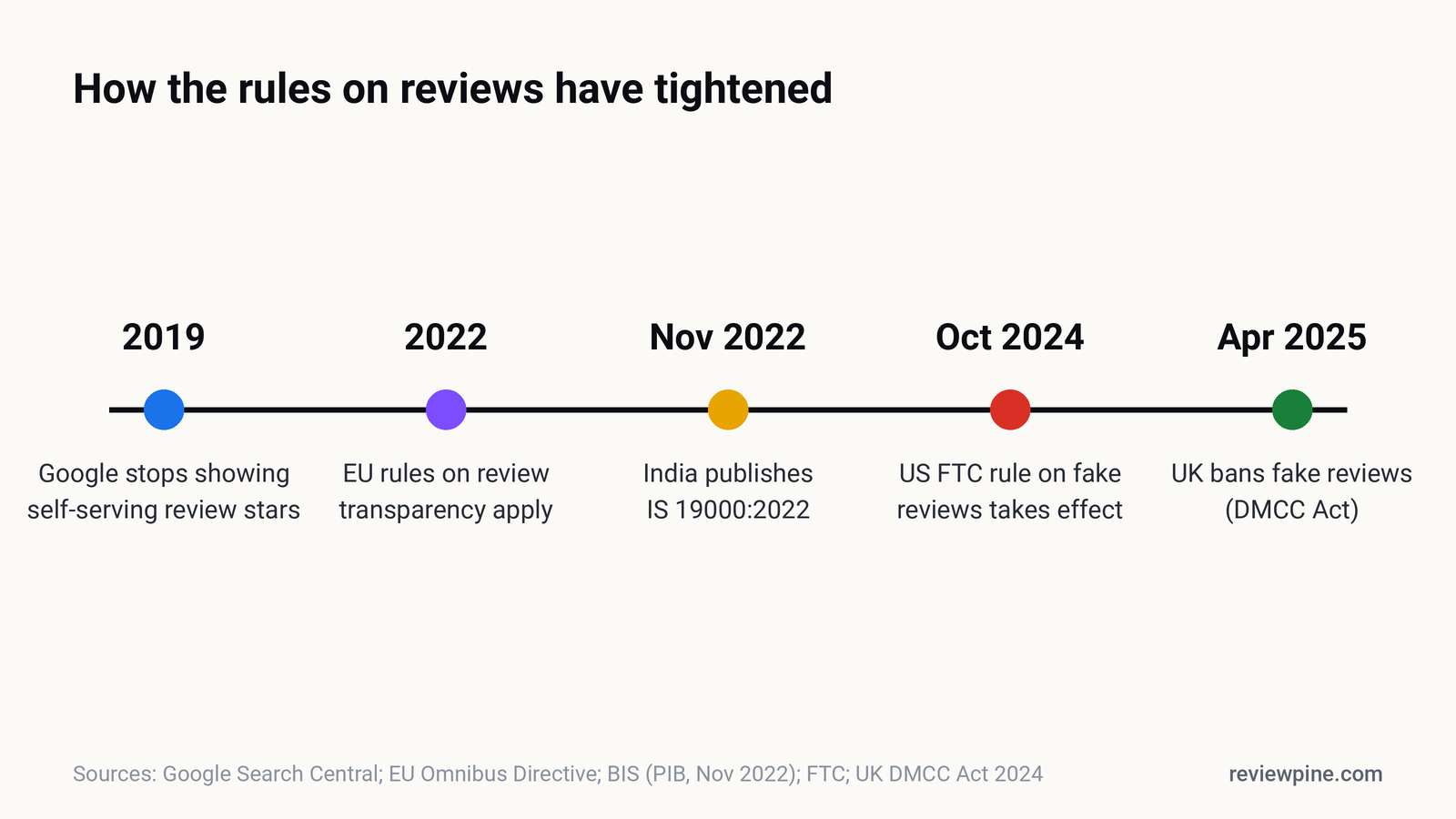
- The UK banned fake reviews from April 2025, and EU rules since 2022 require traders to say whether they verify reviews.
- India's IS 19000:2022 sets principles for collecting and publishing reviews, including no suppression and disclosure of paid reviews.
- Asking every customer for honest feedback remains legal and is the best way to grow reviews.
In several major markets, fake reviews are now illegal, not just against platform rules. In the United States, the FTC's Consumer Reviews and Testimonials Rule, in force since 21 October 2024, bans fake reviews (including AI-generated ones), buying positive or negative reviews, undisclosed insider reviews and review suppression, with civil penalties for knowing violations. The UK and EU have similar bans, and India has published a review standard, IS 19000:2022, while regulators push for stronger enforcement.
This guide summarises the main rules in plain English. It isn't legal advice; if you're unsure about a specific practice, speak to a lawyer in your country. But the practical message is simple, and the same everywhere: reviews must be real, from real customers, and not bought, faked or filtered.
United States: the FTC Consumer Reviews and Testimonials Rule#
The Federal Trade Commission finalised its rule in August 2024 and it took effect on 21 October 2024. The FTC's own Q&A for businesses is the best primary source. In summary, the rule prohibits:
| Practice | What it means |
|---|---|
| Fake or false reviews | Writing, buying or selling reviews that misrepresent who wrote them or their experience, including AI-generated reviews |
| Buying reviews | Offering compensation or incentives conditioned on a review being positive or negative |
| Insider reviews | Reviews by owners, managers, employees or their relatives without clear disclosure of the relationship |
| Company-controlled review sites | Claiming a website is independent when you control it |
| Review suppression | Using threats or intimidation to stop negative reviews, or presenting displayed reviews as all or most reviews while hiding some for being negative |
| Fake social media indicators | Buying or selling fake followers or views to inflate influence |
For knowing violations, the FTC can seek civil penalties per violation (just over $50,000 per violation at the time the rule took effect, adjusted annually for inflation), as well as relief for consumers.
Important: The rule doesn't ban asking customers for reviews. It bans asking in a way that requires or rewards a particular sentiment. Asking every customer for honest feedback remains perfectly fine.
What about the FTC's earlier actions?#
The rule built on years of enforcement. In 2022, the online retailer Fashion Nova agreed to pay $4.2 million to settle FTC charges that it blocked negative product reviews from appearing on its website. The case is a reminder that hiding bad reviews on your own site, not just faking good ones, is a target.
United Kingdom#
The UK's Digital Markets, Competition and Consumers Act 2024 added fake reviews to the list of practices that are always considered unfair. From April 2025, businesses must not commission or publish fake reviews, and must take reasonable steps to prevent and remove them from their platforms, with enforcement by the Competition and Markets Authority. The CMA has also published guidance for businesses on handling reviews fairly.
European Union#
The EU's Omnibus Directive, applied from May 2022, amended consumer protection rules so that:
- traders who show consumer reviews must tell consumers whether and how they check that reviews come from real customers;
- submitting fake reviews, or commissioning others to do it, is banned;
- misrepresenting reviews, for example by only publishing positive ones without saying so, can be an unfair commercial practice.
India#
In November 2022, the Bureau of Indian Standards published IS 19000:2022, "Online Consumer Reviews: Principles and Requirements for their Collection, Moderation and Publication", based on the international standard ISO 20488:2018. It applies to any organisation that publishes consumer reviews, including businesses showing reviews from their own customers. Its principles include:
- reviews must be genuine and from people who actually used the product or service;
- paid or incentivised reviews must be clearly disclosed;
- negative reviews must not be suppressed;
- review administrators should verify reviewers and moderate fairly.
The standard is voluntary for now, but major platforms supported making compliance mandatory, and misleading reviews can also fall under India's Consumer Protection Act, 2019, which deals with unfair trade practices and misleading advertisements.
Platform rules apply everywhere#
Separately from the law, platforms set their own rules, and they apply in every country. Google's user content policies prohibit fake engagement, conflicts of interest and content posted because of an incentive. Google also prohibits businesses from discouraging negative reviews or selectively soliciting positive ones, which rules out review gating. Breaking them can lead to removed reviews and restrictions on your Business Profile.
What should a business never do?#
Across all of these regimes, the same practices come up again and again:
- Never write reviews about your own business, or ask staff, family or friends to, without clear disclosure. On Google, don't do it at all.
- Never buy reviews, from agencies, freelancers or "review exchange" groups.
- Never offer rewards for reviews: discounts, freebies, cashback or prize draws. In the US, offers conditioned on a positive review are unlawful; on Google, any incentive breaks the rules.
- Never hide or filter out negative reviews while presenting what's left as the full picture.
- Never threaten or pressure customers into removing or changing a review.
- Never use AI to generate reviews or testimonials attributed to customers who didn't write them.
- Never post fake negative reviews about competitors.
What can you safely do?#
| Safe practice | Notes |
|---|---|
| Ask every customer for an honest review | The single best way to grow reviews; see how to get more Google reviews |
| Make it easy with a direct link or QR code | Convenience isn't an incentive |
| Reply to all reviews, positive and negative | Builds trust; see responding to negative reviews |
| Feature selected reviews on your website | Show your overall rating, total count and a link to all reviews |
| Report reviews that break platform rules | Fake, abusive or conflicted reviews can be flagged |
| Fix problems and let customers update reviews themselves | Never make a fix conditional on changing the review |
How do you show reviews on your website honestly?#
Many businesses show a selection of reviews on their site, and that's normal. The honest way to do it, which also protects you under suppression rules:
- show your overall rating and total review count from the source platform;
- show real names and dates as they appear on the platform;
- link to the full profile, so anyone can read every review;
- don't edit reviewers' words, and don't present a selection as everything.
ReviewPine widgets show your Google rating and total review count in the header, display reviews as they appear on Google with dates, and attribute them to Google, so visitors always have the context.
The bottom line#
The direction of travel is clear in every major market: regulators expect reviews to reflect real customers' real experiences. That's good news for honest businesses, because the competitors who cut corners are taking on real legal risk. Ask every customer, never pay for praise, never hide criticism, and reply to everything. ReviewPine helps you put those genuine reviews to work on your website, with the transparency the rules increasingly expect.
This article is general information, not legal advice. Laws change and differ by country; consult a qualified lawyer about your specific situation.
Frequently asked questions
Is it illegal to buy Google reviews?
Can I offer customers a discount for leaving a review?
Is it illegal for employees to review their own company?
Can I remove negative reviews from my website?
Are there rules about reviews in India?
Turn your Google reviews into your best salesperson
Show real, always-fresh Google reviews on any page of your website, with a "Write a review" button that brings in new ones. Set up in about two minutes.
- Works on WordPress, Shopify, Wix and any site
- Updates itself every day
- No cookies, no slowdown
Anjanee Shukla
Founder, Ainygo Technologies
Anjanee Shukla is the founder of Ainygo Technologies and has been working in the technology industry for over 15 years. He has helped businesses worldwide by developing more than 1,000 websites, web applications, and digital solutions. His expertise spans WordPress, web development, website maintenance, hosting, automation, and business technology. Through this blog, he shares practical advice, technical knowledge, and real-world solutions gained from years of hands-on experience.