What Is Review Gating, and Why It Can Get Your Business in Trouble
Sending happy customers to Google and unhappy ones to a private form feels clever. It breaks Google's rules, can breach consumer protection law, and there's an honest alternative that works better.
On this page
Key takeaways
- Review gating means screening customers and sending only happy ones to public review sites.
- Google prohibits discouraging negative reviews or selectively asking for positive ones.
- In the US, filtering out negative reviews can count as review suppression under the FTC rule in force since October 2024.
- Fashion Nova paid $4.2 million in 2022 to settle FTC charges of blocking negative reviews.
- The compliant alternative: send every customer the same public review link, with an optional private line for problems.
- On your own website, feature reviews honestly by showing your overall rating, total count and a link to all reviews.
Review gating is the practice of screening customers before asking for a review, then sending only the satisfied ones to a public review site while steering unhappy customers to a private feedback form. Google prohibits it: businesses must not discourage negative reviews or selectively ask for positive ones. In the United States, filtering out negative reviews can also count as review suppression under the FTC's rules on consumer reviews.
It's one of the most common "growth hacks" sold to local businesses, and one of the riskiest. This guide explains how gating works, why platforms and regulators object to it, and a compliant way to collect feedback that still protects your reputation.
How does review gating work?#
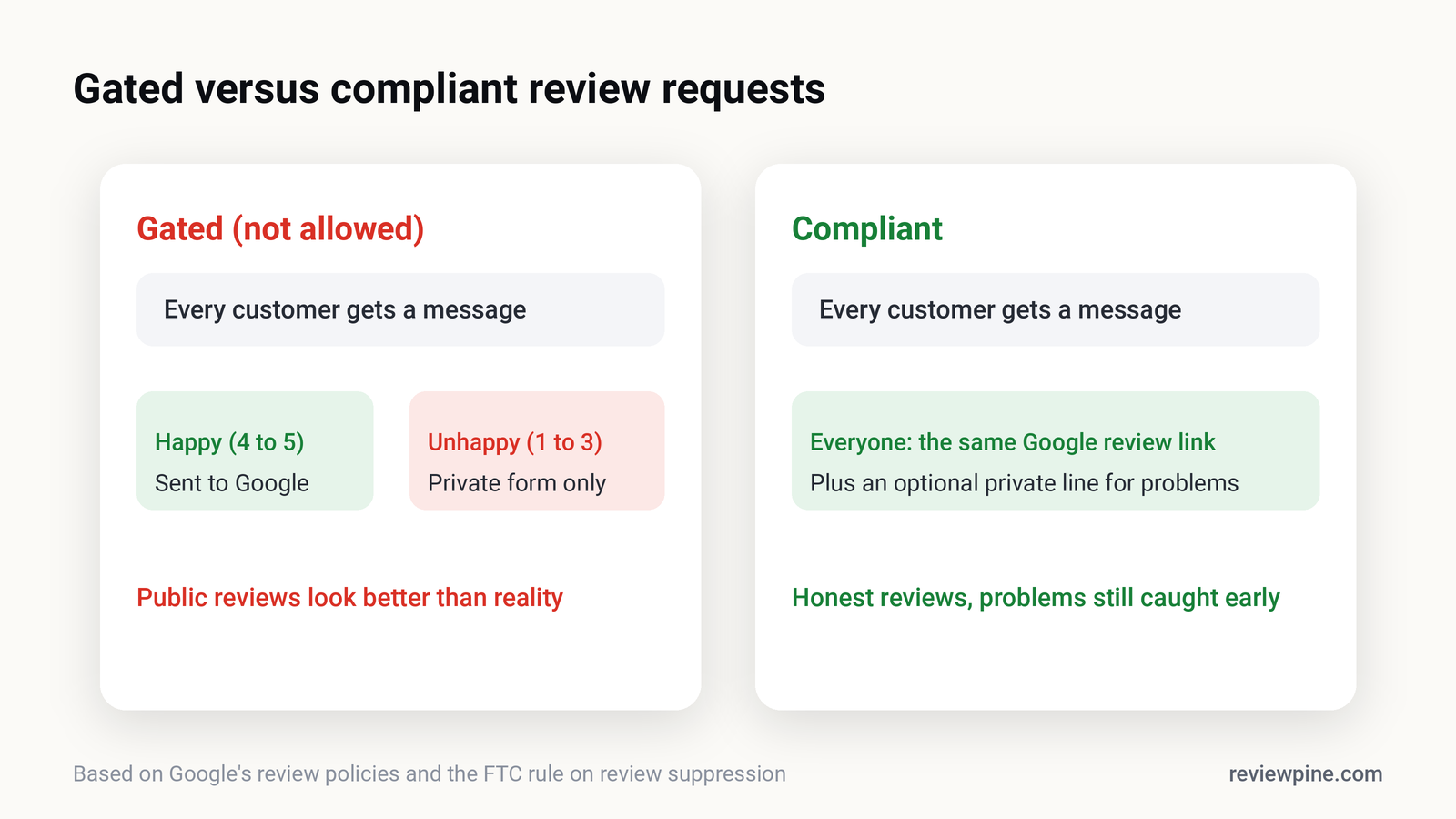
A typical gated flow looks like this:
- After a purchase, the customer gets a message: "How would you rate your experience?"
- If they pick 4 or 5 stars, they're sent to your Google review page.
- If they pick 1 to 3 stars, they're sent to a private form, and never shown the public review link.
The result is a public profile that over-represents happy customers. That's exactly why it's attractive, and exactly why it's banned.
Why does Google prohibit review gating?#
Because it makes reviews misleading. A review profile is only useful to the public if it reflects what customers actually experienced. Google's policies for business owners state that businesses shouldn't discourage or prohibit negative reviews or selectively solicit positive reviews from customers. Google updated its guidance in 2018 to make this explicit, after review-management tools had popularised the practice.
The consequences can include removal of reviews and restrictions on your Business Profile. Even if nothing happens immediately, a profile built on gating is fragile: one policy sweep can wipe out years of work.
Is review gating illegal?#
It depends on where you are and how it's done, and we're not lawyers, so take specific legal advice if you're unsure. But regulators are paying attention:
- United States: The FTC's Consumer Reviews and Testimonials Rule, in force since October 2024, prohibits review suppression. That includes misrepresenting that the reviews you display represent most or all reviews when you're suppressing some based on their rating or negative sentiment. Before the rule, the FTC had already acted on suppression: in 2022 the online retailer Fashion Nova agreed to pay $4.2 million to settle charges that it blocked negative reviews from appearing on its website.
- India: The Bureau of Indian Standards published IS 19000:2022, a standard for collecting, moderating and publishing online consumer reviews. It's voluntary for now, but its principles, including not suppressing negative reviews, show the direction of travel.
- UK and EU: Consumer protection rules also target fake and misleading reviews, including hiding negative ones.
The safe assumption anywhere: if your process makes your reviews look better than your customers' real experience, it's a risk.
Gating versus legitimate feedback: where's the line?#
Asking for feedback is fine. Fixing problems before a customer posts a review is fine. The line is crossed when some customers are denied the same opportunity to post publicly because of what they said.
| Practice | Allowed? |
|---|---|
| Asking every customer for a Google review with the same message | Yes |
| Sending a private satisfaction survey to every customer | Yes |
| Offering every customer the public review link, whatever their score | Yes |
| Showing the public link only to customers who rated you 4 or 5 | No: this is gating |
| Asking only customers you think were happy | No: selective solicitation |
| Asking unhappy customers not to post publicly until you fix things | Risky: it discourages negative reviews |
| Offering a refund on condition the review is removed or changed | No: incentivised revision breaks Google's policies |
What's the compliant alternative?#
Keep the useful part of gating, catching problems early, and drop the part that hides them. Here's a flow that works and stays within the rules:
- Ask every customer the same way. One message, one review link, sent to everybody.
- Optionally, include a private line too. "If anything wasn't right, reply to this message and I'll personally sort it out." Show it to everyone, alongside the public link, not instead of it.
- Fix problems fast. When someone replies with a complaint, solve it. Many will update their own review afterwards, unprompted.
- Reply publicly to every review, including negative ones, calmly and specifically. Our guide to responding to negative reviews has templates.
This approach usually produces a better profile than gating in the long run. Your reviews are trusted because they're clearly real, and the occasional complaint answered well persuades readers more than a wall of perfect scores.
Can I choose which reviews to show on my own website?#
Choosing which reviews to feature on your website is common and generally fine, as long as you don't mislead people about the bigger picture. Two simple habits keep you on the right side:
- Show your overall rating and total number of reviews next to the reviews you feature.
- Link to your full Google profile, so anyone can read every review.
Avoid presenting a hand-picked selection as if it were all your reviews. In the US, that kind of misrepresentation is exactly what the FTC's suppression rule targets. Our guide to fake review laws covers the rules in more detail.
Does review gating even work?#
In the short term, it can lift a star rating. In the long term, it tends to backfire:
- Readers increasingly distrust perfect profiles. The Spiegel Research Center found purchase likelihood peaks between roughly 4.0 and 4.7 stars, falling towards a perfect 5.0.
- Unhappy customers who were blocked from your review link often find another way to complain, on Google or social media, and they're angrier for having been ignored.
- A policy enforcement or legal complaint can undo years of reviews at once.
The better way to protect your rating#
Collect more reviews, from everyone, consistently. A profile with a steady flow of honest reviews absorbs the occasional bad one without much effect on the average. See how to get more Google reviews for a policy-safe playbook.
When you show reviews on your website, ReviewPine displays your real Google reviews together with your overall Google rating and total count, with a link to your full profile, so visitors get honest context while you feature the reviews that best answer their questions.
Frequently asked questions
What is review gating?
Is review gating against Google's policy?
Is review gating illegal?
Can I send a satisfaction survey before asking for a review?
Can I show only positive reviews on my website?
Turn your Google reviews into your best salesperson
Show real, always-fresh Google reviews on any page of your website, with a "Write a review" button that brings in new ones. Set up in about two minutes.
- Works on WordPress, Shopify, Wix and any site
- Updates itself every day
- No cookies, no slowdown
Anjanee Shukla
Founder, Ainygo Technologies
Anjanee Shukla is the founder of Ainygo Technologies and has been working in the technology industry for over 15 years. He has helped businesses worldwide by developing more than 1,000 websites, web applications, and digital solutions. His expertise spans WordPress, web development, website maintenance, hosting, automation, and business technology. Through this blog, he shares practical advice, technical knowledge, and real-world solutions gained from years of hands-on experience.