How to Respond to Negative Reviews (With 9 Templates You Can Adapt)
A bad review is read by every future customer, and so is your reply. A calm five-step method, nine adaptable templates, and the mistakes that turn one complaint into a reputation problem.
On this page
- Why does replying to negative reviews matter so much?
- How fast should you reply?
- The 5-step method for any negative review
- 9 templates for common negative reviews
- What should you never do in a reply?
- When should you report a review instead?
- How do negative reviews affect your overall rating?
- Can negative reviews actually help?
- Make good replies part of your routine
Key takeaways
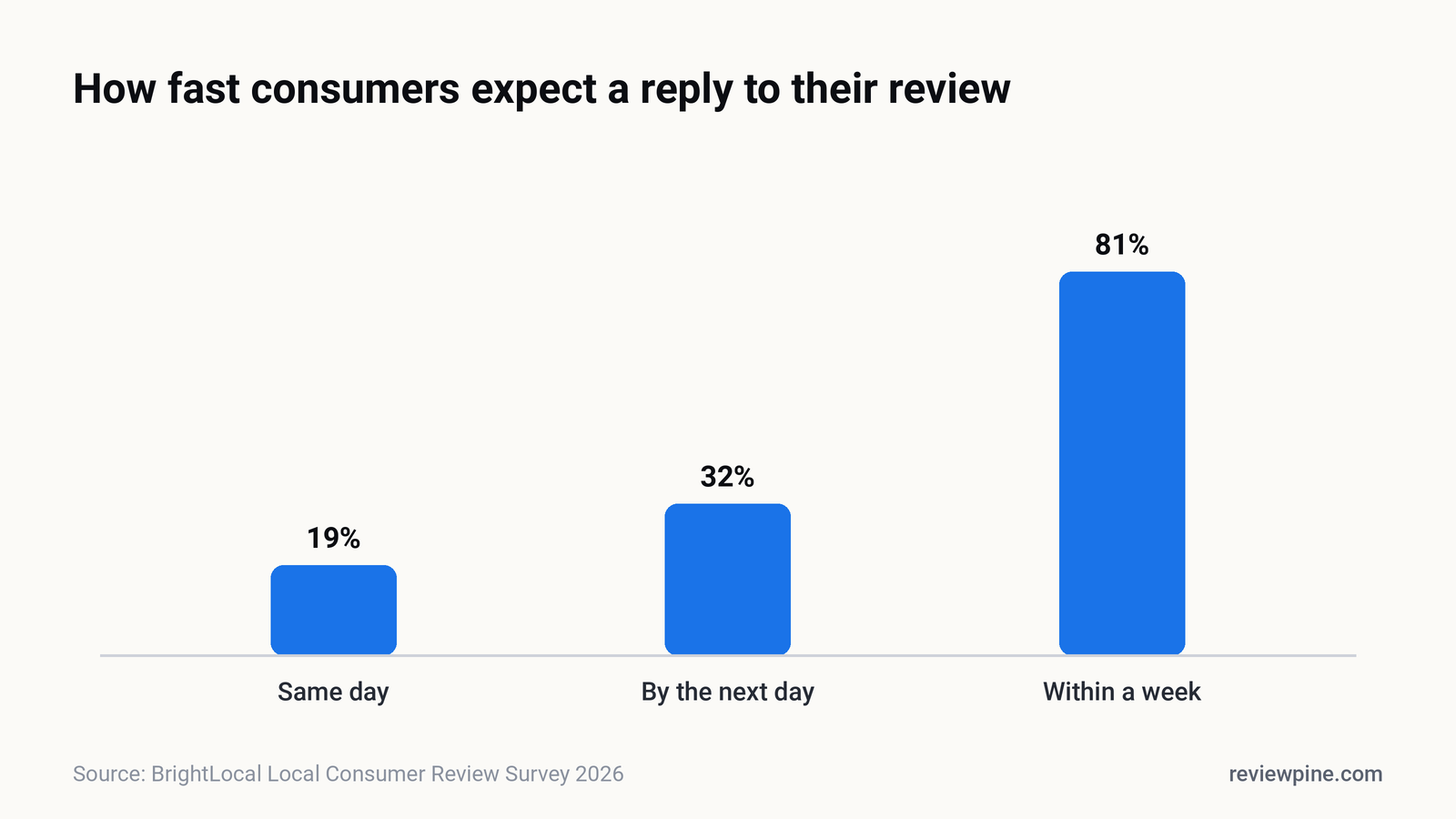
- Reply to negative reviews within 24 hours on working days; 19% of consumers now expect a same-day reply (BrightLocal, 2026).
- Thank the reviewer, name the specific problem, apologise for their experience and move details offline.
- Write a fresh reply every time: templated replies put off 50% of consumers.
- Never argue, share private details or offer incentives to change a review.
- Report reviews only when they break platform rules, and reply politely while you wait.
- More reviews are the best protection: a few critical reviews among many positive ones make the profile more believable.
To respond to a negative review, reply publicly within a day or two, thank the reviewer, acknowledge the specific problem, apologise for their experience without arguing, explain briefly what you're doing about it, and offer to continue the conversation privately. Keep it short, specific and human. Your reply isn't really for the angry customer; it's for the hundreds of future customers who will read both the complaint and how you handled it.
This guide gives you a method you can use every time, nine templates for the situations businesses face most, and the replies that make things worse.
Why does replying to negative reviews matter so much?#
Because silence reads as indifference, and an argument reads as a warning. BrightLocal's 2026 consumer survey found that 89% of consumers expect business owners to respond to reviews, and 42% are unlikely to use a business that ignores its reviews entirely. Meanwhile, 37% said an owner's response is one of the things that makes a review more trustworthy.
A good reply can turn a negative review into one of the most persuasive things on your profile. A prospective customer reading "the delivery was two days late" followed by a reply that owns the mistake and explains the fix learns something more valuable than another five-star review: what happens when things go wrong with you.
How fast should you reply?#
Faster than most businesses think. Expectations jumped in the 2026 survey: 19% of consumers expect a reply the same day (up from 6%), 32% by the next day, and 81% within a week.
A practical target: reply to negative reviews within 24 hours on working days. If you need to investigate first, post a short holding reply ("We're sorry, we're looking into this today and will reply properly") rather than leaving the review unanswered for a week.
The 5-step method for any negative review#
1. Pause before you type#
Never reply angry. Read the review, step away, and come back when you can read it as a stranger would. If the review stings, that's exactly when a bad reply gets written.
2. Thank them and use their name#
"Thank you for taking the time to tell us about this, Priya." It sounds small, but it signals that you're listening rather than defending.
3. Acknowledge the specific problem#
Name what went wrong in their words: the wait, the cold food, the missed call-back. Specificity is what separates a real reply from a template. BrightLocal found generic or templated replies put off 50% of consumers.
4. Apologise for the experience, then explain briefly#
You can sincerely apologise for how someone felt without accepting every claim. Then, if there's a genuine reason or a fix, explain it in one or two sentences. Skip long explanations; they read as excuses.
5. Move it offline with a real contact#
Give a name and a direct way to reach someone who can help, so the details are sorted out privately. Never ask for personal information in the public reply.
Tip: Write the reply as if the reviewer's friend, your best prospective customer and a journalist are all going to read it. Usually, all three will.
9 templates for common negative reviews#
Adapt these; don't paste them unchanged. A reply that reads like a template defeats the purpose.
1. Slow service or long wait
Thank you for the honest feedback, Rahul, and I'm sorry you waited so long on Saturday. That isn't the experience we want anyone to have. We were short-staffed that afternoon and should have told you how long the wait would be. We've since changed our weekend rota. I'd love to make it up to you; please ask for me, Meera, next time you visit or call 98XXX XXXXX.
2. Product didn't meet expectations
Thanks for letting us know, Daniel. I'm sorry the jacket didn't fit the way you expected. Our sizing guide clearly isn't clear enough, and we're updating it this week. Please reply to your order email or write to [email protected] and we'll arrange an exchange or a refund, whichever you prefer.
3. Rude or unhelpful staff
I'm really sorry, Aisha. Nobody should be spoken to that way, and it isn't how we expect our team to treat customers. I've spoken to the team member involved. I'd appreciate hearing more about what happened; could you call me directly on 98XXX XXXXX? I'm the manager here, and I'll make this right.
4. Pricing complaint
Thanks for the feedback, Mark. I understand the final bill was higher than you expected, and I'm sorry we didn't explain the extra parts before starting the work. That's on us. We now confirm every additional cost in writing before we go ahead. I'd like to go through your invoice with you; please call me on 98XXX XXXXX.
5. A mistake you clearly made
You're absolutely right, Sana, and I'm sorry. We sent the wrong order and then took too long to fix it. There's no excuse. We've refunded your delivery fee today and added a check before every dispatch so it doesn't happen again. Thank you for telling us; it genuinely helps.
6. Vague one-star review with no details
Thank you for your rating, Arjun. I'm sorry we fell short, and I'd like to understand what went wrong so we can fix it. Could you get in touch at [email protected] or 98XXX XXXXX? I read every message myself.
7. Reviewer who isn't a customer (possibly fake)
Thank you for your review. We can't find any booking or visit under this name, and we take every comment seriously, so we'd like to look into it. Please contact us at [email protected] with any details so we can help.
Stay polite even when you suspect a fake: readers can't tell, and a calm reply makes you look credible either way. Then report it (see below).
8. Complaint that's factually wrong
Thanks for sharing this, Kiran. I'm sorry the visit left you frustrated. To clarify for anyone reading: our consultation fee is shown on the booking page and confirmed by SMS before every appointment. I'd still like to understand where it felt unclear, so please call me on 98XXX XXXXX.
9. An old review about a problem you've since fixed
Thank you for this feedback, Lisa, and I'm sorry it took us so long to reply. You were right about the parking. Since then we've arranged parking at the building next door, free for our customers. We'd love the chance to show you the difference.
What should you never do in a reply?#
| Don't | Why |
|---|---|
| Argue or prove the customer wrong | You might win the point and lose every reader |
| Copy the same reply on every review | Readers spot it instantly; 50% are put off by templated replies |
| Share private details (bookings, medical or account info) | It breaches trust and, in some sectors, privacy rules |
| Offer a discount to remove or change the review | Asking for revision in exchange for an incentive breaks Google's policies |
| Threaten legal action in public | It makes a small complaint look like a big story |
| Ignore it and hope it sinks | Silence is visible, and 42% avoid businesses that never reply |
When should you report a review instead?#
Report a review when it breaks the platform's rules, not just because it's negative. On Google, that includes spam and fake engagement, content from someone who wasn't a customer, conflicts of interest (such as a competitor or ex-employee), offensive or harassing language, and personal information. You can flag the review from your Business Profile; Google reviews it against its user content policies.
Reply professionally while you wait. Removal isn't guaranteed and can take time, and the review stays visible to everyone in the meantime.
How do negative reviews affect your overall rating?#
Less than they feel like they do, if you keep collecting reviews. One three-star review among forty-five-star reviews barely moves the average. The real risk is a thin profile, where a single bad review can drop your rating sharply. The best long-term protection against negative reviews is more reviews: ask every customer, so that the occasional complaint sits in honest context. See how to get more Google reviews.
Can negative reviews actually help?#
Yes. Research by Northwestern's Spiegel Research Center found purchase likelihood peaks at ratings between roughly 4.0 and 4.7, falling as ratings approach a perfect 5.0, because flawless records look suspicious. A handful of critical reviews, answered well, makes all the positive ones more believable. We dig into this in is a perfect 5-star rating bad for business?
Make good replies part of your routine#
Set a fixed time, ideally daily, to check new reviews. Reply to positive ones too; they deserve thanks and it shows readers you're paying attention (our guide to replying to positive reviews has examples). And when you show your Google reviews on your website, show real ones with your overall rating and count. Visitors trust a business that clearly isn't hiding anything.
ReviewPine displays your genuine Google reviews on your website, alongside your overall rating and total review count, and lets you choose which reviews to feature while linking visitors to the full picture on Google.
Frequently asked questions
Should I respond to every negative review?
How long should a reply to a negative review be?
Can I get a negative Google review removed?
Should I offer compensation to a customer who left a bad review?
What if a negative review is fake?
Turn your Google reviews into your best salesperson
Show real, always-fresh Google reviews on any page of your website, with a "Write a review" button that brings in new ones. Set up in about two minutes.
- Works on WordPress, Shopify, Wix and any site
- Updates itself every day
- No cookies, no slowdown
Anjanee Shukla
Founder, Ainygo Technologies
Anjanee Shukla is the founder of Ainygo Technologies and has been working in the technology industry for over 15 years. He has helped businesses worldwide by developing more than 1,000 websites, web applications, and digital solutions. His expertise spans WordPress, web development, website maintenance, hosting, automation, and business technology. Through this blog, he shares practical advice, technical knowledge, and real-world solutions gained from years of hands-on experience.