Testimonials vs Google Reviews: Which Builds More Trust on Your Website?
A handpicked quote and a Google review can say the same thing, but visitors don't trust them equally. The key differences, when each one works best, and how to combine them without losing credibility.

On this page
- What's the difference?
- Why do visitors trust reviews more?
- When do testimonials work better?
- Are there rules for testimonials?
- How should you combine testimonials and reviews?
- Can you turn Google reviews into testimonials?
- What about embedding reviews from Google?
- How do you collect a strong testimonial?
- The bottom line
Key takeaways
- Testimonials are chosen and published by the business; Google reviews are written by customers on an independent platform.
- Visitors trust reviews more because they're independent, verifiable, current and come with an overall rating.
- Named reviewers (35%) and owner responses (37%) make reviews more trustworthy (BrightLocal, 2026).
- Testimonials work best for detailed case studies, video and specialist services.
- Testimonials are advertising: they must be genuine, used with permission, and disclose any payment or relationship.
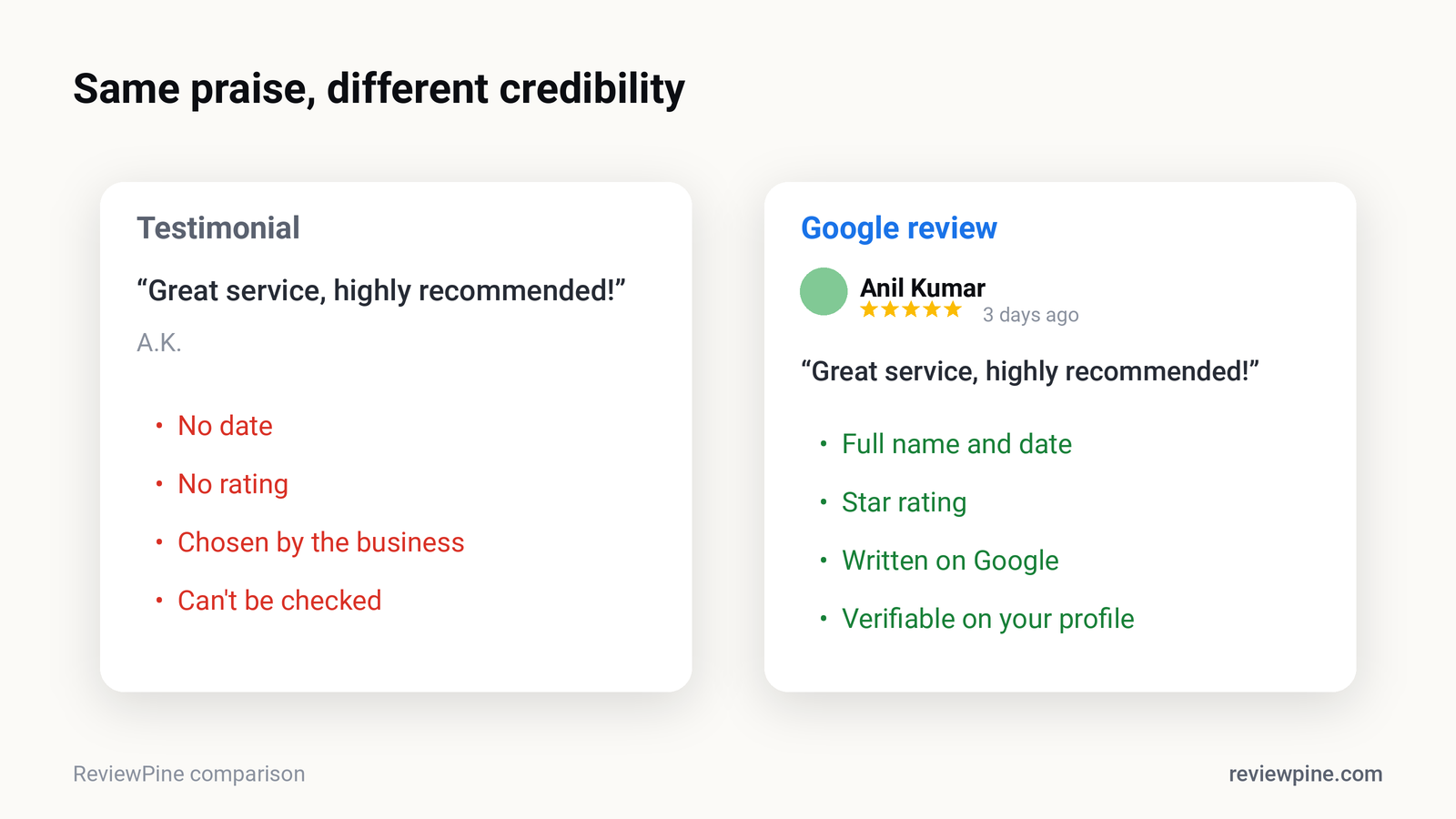
Testimonials are quotes a business collects and chooses to publish itself; Google reviews are written by customers on an independent platform, with names, dates and ratings the business can't edit. Visitors generally trust independent reviews more, because they can verify them and because they know the business didn't pick only the best. Testimonials still have a place, especially for detailed case studies, but they work best alongside verifiable reviews, not instead of them.
Here's how they differ, when each one earns its space, and how to use both without undermining your credibility.
What's the difference?#
| Testimonials | Google reviews | |
|---|---|---|
| Who writes it | A customer, usually at the business's request | A customer, on Google |
| Who decides it's published | The business | The customer (subject to Google's policies) |
| Can the business edit it? | Often, at least for length | No |
| Verifiable by visitors | Rarely | Yes, on your public Google profile |
| Shows negatives too | Almost never | Yes, the full range |
| Has a date and rating | Often not | Always |
| Stays current | Only if updated manually | New reviews arrive continuously |
Why do visitors trust reviews more?#
Independence#
A testimonial on your homepage is, by definition, something you chose to show. Visitors know that. A Google review lives on a platform you don't control, among all your other reviews, good and bad.
Verifiability#
A Google review shown with the reviewer's name, the date and a link to your profile can be checked in seconds. BrightLocal's 2026 survey found that a reviewer being named rather than anonymous (35%) and the business owner having responded (37%) are among the things that make a review more trustworthy.
Recency#
Testimonials tend to be collected once and left for years. Reviews keep arriving. With 74% of consumers only caring about reviews from the last three months, freshness is a credibility signal in itself.
Context#
Reviews come with your overall rating and the total count. A single glowing quote tells visitors nothing about the other ninety-nine customers; a 4.7 from 180 reviews does.
When do testimonials work better?#
Testimonials still win in a few situations:
- Detailed stories and case studies. A B2B client describing the project, the result and the numbers can go far deeper than a review. Long-form case studies are persuasive precisely because of the detail.
- Video. A short video of a real client is hard to fake and very persuasive, as long as it's genuine and you have their permission.
- Specialist audiences. For high-value or niche services with few public reviews, a recognisable client's endorsement can carry more weight than a handful of reviews.
- Industries where public reviews are rare or sensitive, such as some legal and medical services, where clients may prefer not to post publicly.
Are there rules for testimonials?#
Yes. Testimonials are advertising, so they're covered by advertising and consumer protection rules. In the US, the FTC's Endorsement Guides and its 2024 rule on reviews and testimonials require testimonials to reflect genuine experiences, prohibit fake ones (including AI-generated testimonials), and require disclosure of material connections, such as paying a client or giving them a discount for their testimonial. Many other countries have similar principles. Practical rules of thumb:
- only publish real words from real clients, with their permission;
- don't present an unusual result as typical;
- disclose any payment, discount or relationship;
- keep a record of the original testimonial and consent.
How should you combine testimonials and reviews?#
Use each for what it does best:
| Page | Best format |
|---|---|
| Homepage | Live Google reviews with your overall rating, plus one standout testimonial or case study link |
| Service pages | Google reviews filtered to that service |
| Contact and booking pages | Short Google reviews about responsiveness and reliability |
| Case study pages | Full client stories, with results and permission |
| Pricing page | Reviews mentioning value, plus a client quote about return on investment |
The rule of thumb: let independent reviews carry the general credibility, and use testimonials for depth.
Can you turn Google reviews into testimonials?#
You can quote a customer's Google review on your website, ideally showing it as a review, with their name, date, rating and the Google source. That keeps it verifiable. If you want to use a review in an advert or a brochure, ask the customer's permission first, and never change their words.
What you shouldn't do is lift the text of a review, strip the name and date, and present it as an anonymous testimonial. It removes everything that made it trustworthy.
What about embedding reviews from Google?#
Embedding live Google reviews gives you the strengths of both: the independence and verifiability of reviews, presented in a design that fits your site. A good review widget shows names, dates, ratings and your overall score, attributes the reviews to Google and updates by itself as new reviews arrive. See how to add Google reviews to your website.
How do you collect a strong testimonial?#
When a detailed client story is the right tool, a little structure makes it far more useful. Ask three questions, by email or in a short call:
- What was the situation before you worked with us? This sets up the problem readers recognise.
- What did we do, and what was it like working with us? This covers the experience.
- What changed afterwards? Results, ideally specific: time saved, enquiries gained, a problem solved.
Then write it up in the client's own words, send it back for approval, and get written permission to publish it with their name, role and company. If they're happy to, add a photo or a short video. A testimonial built this way reads like a mini case study, which is exactly where testimonials outperform reviews.
| Testimonial element | Why it helps |
|---|---|
| Full name, role and company | Makes it verifiable and credible |
| A specific before and after | Shows a real outcome, not general praise |
| The client's own words | Feels authentic; heavy editing reads as marketing |
| A photo or short video | Hard to fake and very persuasive |
| Date | Shows it's current |
The bottom line#
Testimonials tell visitors what you want them to hear. Reviews tell them what customers actually said. Lead with verifiable Google reviews, add carefully sourced testimonials and case studies for depth, and keep both honest. ReviewPine shows your live Google reviews on any website, each with the reviewer's name, rating, date and Google attribution, so visitors can see your reputation is real.
Frequently asked questions
What is the difference between a testimonial and a review?
Are Google reviews more trustworthy than testimonials?
Can I use Google reviews as testimonials on my website?
Do testimonials need permission?
Should I use testimonials or reviews on my homepage?
Turn your Google reviews into your best salesperson
Show real, always-fresh Google reviews on any page of your website, with a "Write a review" button that brings in new ones. Set up in about two minutes.
- Works on WordPress, Shopify, Wix and any site
- Updates itself every day
- No cookies, no slowdown
Anjanee Shukla
Founder, Ainygo Technologies
Anjanee Shukla is the founder of Ainygo Technologies and has been working in the technology industry for over 15 years. He has helped businesses worldwide by developing more than 1,000 websites, web applications, and digital solutions. His expertise spans WordPress, web development, website maintenance, hosting, automation, and business technology. Through this blog, he shares practical advice, technical knowledge, and real-world solutions gained from years of hands-on experience.