How Many Google Reviews Do You Need? A Realistic Target for Your Business
There's no magic number, but there are thresholds buyers use. What the research says about the first 5, the first 20 and "enough", and how to set a target based on your actual competitors.

On this page
- What does the research say?
- The three thresholds that matter
- Does it matter more how recent the reviews are?
- How do you set a target for your business?
- Does the number of reviews differ by industry?
- Is there such a thing as too many reviews?
- Can you speed it up without breaking rules?
- What about reviews on other platforms?
- A simple monthly review dashboard
- Make every review count twice
Key takeaways
- Products with five reviews were 270% more likely to be bought than those with none (Spiegel Research Center).
- 47% of consumers won't use a business with fewer than 20 reviews; only 9% accept five or fewer (BrightLocal, 2026).
- Recency matters: 74% of consumers only care about reviews from the last three months.
- Set your target by benchmarking the top three businesses in your local map results.
- Beyond a healthy count, replies, freshness and showing reviews on your website add more than volume.
Most local businesses need at least 20 recent Google reviews to clear the bar most customers set, and enough to match or beat the businesses they compete with in the map results. Research shows the first handful of reviews makes the biggest difference: products with five reviews were 270% more likely to be bought than those with none. After that, a steady flow of fresh reviews matters more than chasing a huge total.
Here's what the evidence says about each threshold, and a simple way to set a target that fits your market rather than someone else's.
What does the research say?#
Two sources are especially useful.
Northwestern University's Spiegel Research Center analysed reviews and purchase data at scale and found that the jump from zero to five reviews increased purchase likelihood by 270%. They also found that the benefit of additional reviews diminishes quickly after the first few: the first five drive the bulk of the effect.
BrightLocal's 2026 Local Consumer Review Survey looked at what local customers expect. It found 47% of consumers won't use a business with fewer than 20 reviews, and only 9% are comfortable with a business that has five or fewer.
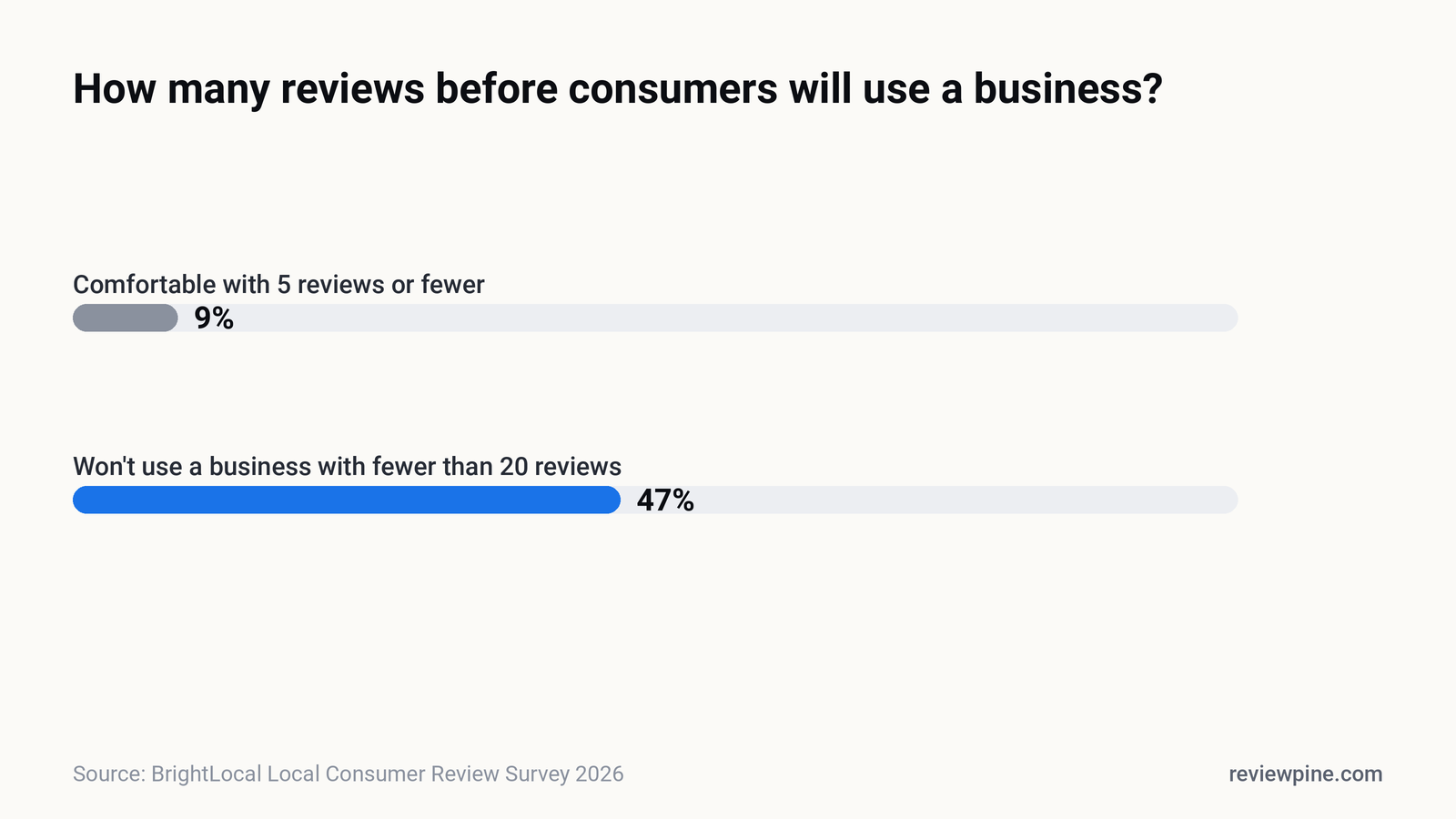
Put those together and you get a clear picture: getting from nothing to a handful of reviews is the single biggest jump in trust, and getting past twenty removes a barrier for nearly half your potential customers.
The three thresholds that matter#
| Threshold | What it signals | Priority |
|---|---|---|
| First 5 reviews | "This is a real business people use" | Urgent if you're below it |
| 20+ reviews | Established and trustworthy for most buyers | The minimum target for most businesses |
| Ahead of competitors | You're the obvious choice in the local results | The real long-term goal |
Why the first five matter most#
With zero reviews, a buyer has no evidence at all. With one or two, a single opinion can dominate. With five, there's a pattern. That shift from "unknown" to "real people vouch for this" is the biggest trust jump you'll ever get, which is why a new business should treat its first five reviews as a priority task in the first month.
Why 20 is the practical minimum#
Twenty reviews is where a profile starts to look established rather than new. It's also where a single negative review stops dominating your rating: one three-star review among twenty barely moves the average, whereas among four it can drag you below the 4-star line that 68% of consumers now use as a filter.
Does it matter more how recent the reviews are?#
For many buyers, yes. BrightLocal found 74% of consumers only care about reviews written in the last three months, and 32% look for reviews from the last two weeks. A profile with 150 reviews where the newest is a year old raises a question the business can't answer: are they still this good?
That's why a weekly flow of reviews beats an occasional big push. Ten new reviews spread across a quarter keep your profile current; ten in one week followed by silence don't. Read more in review recency.
How do you set a target for your business?#
Use your competition, not a generic number:
- Search the way your customers do. For example, "physiotherapist in Indiranagar" or "plumber near me" from your area.
- Note the three businesses in the map results. Write down each one's review count, rating and the date of their newest review.
- Set a 6-month target of at least the median count, with reviews no older than a month.
- Divide by 26 to get a weekly number. That's your real target.
| Your situation | Sensible next target |
|---|---|
| 0 to 4 reviews | Reach 5 this month, then 20 |
| 5 to 19 reviews | Reach 20, with at least one new review a week |
| 20 to 50 reviews | Match the top local competitor, keep reviews under a month old |
| 50+ reviews | Focus on freshness, replies and showing reviews on your website |
Example: A dental clinic finds its three map competitors have 64, 112 and 38 reviews, with the newest from last week. The median is 64. The clinic has 23. To reach 64 in six months it needs about 41 more, or under two a week, which is very achievable if every patient is asked.
Does the number of reviews differ by industry?#
Yes. Restaurants and cafés serve many customers a day and often have hundreds of reviews. A specialist lawyer or an industrial supplier might lead their market with thirty. High-value services usually have fewer reviews, but each one carries more weight, because buyers read them more carefully: Spiegel found the effect of reviews on purchases was larger for higher-priced items (380% versus 190% for lower-priced ones). That's why benchmarking against your actual competitors is more useful than any universal figure.
Is there such a thing as too many reviews?#
Not really, but there's a point of diminishing returns for trust. Beyond a healthy number, more reviews add less confidence than better reviews, more recent reviews and good replies. At that stage, the bigger gains usually come from:
- replying to every review (80% of consumers favour businesses that reply to all, per BrightLocal);
- making sure reviews mention the services you want to be known for, by asking open questions;
- putting your reviews where buyers make decisions, on your website.
Can you speed it up without breaking rules?#
Yes, by asking more consistently, not by shortcuts. Ask every customer, send a direct link, follow up once, and add your link to receipts and confirmations. Our guides on getting more Google reviews and review request templates cover the details. Never buy reviews, offer rewards for them, or ask only happy customers: Google prohibits all three, and the US FTC can fine businesses for fake or bought reviews (see fake review laws).
What about reviews on other platforms?#
Google matters most for most local businesses, but buyers don't only look there. BrightLocal's 2026 survey found Facebook, Apple Maps, Tripadvisor and industry sites all gained usage, with Apple Maps nearly doubling from 14% to 27%. Your target should cover the two or three platforms your customers actually use:
| Business type | Platforms worth a target beyond Google |
|---|---|
| Restaurants and cafés | Zomato or Yelp, Tripadvisor, Facebook |
| Hotels and travel | Tripadvisor, Booking.com, Google |
| Doctors and clinics | Practo (India), Healthgrades (US), Facebook |
| Home services | Facebook, Houzz, Justdial (India) |
| B2B and agencies | Clutch, LinkedIn recommendations, G2 for software |
You don't need the same volume everywhere. A healthy Google profile plus a respectable presence on one industry platform covers most buyers' checks.
A simple monthly review dashboard#
Once you've set a target, track four numbers on the first working day of each month. It takes five minutes and tells you whether your review habit is working:
- Total Google reviews and the change since last month.
- Average rating and whether it moved.
- Age of your newest review (aim for under two weeks).
- Reply rate: how many of last month's reviews have an owner reply (aim for all of them).
If the total isn't growing, look at where review requests are being skipped. If the rating dips, read the recent reviews for a recurring theme. If replies lag, schedule a fixed weekly slot. Small, regular checks prevent the slow drift that leaves a profile looking abandoned.
Make every review count twice#
Every review you earn does its job on Google. Show the same reviews on your own website and it works a second time, at the moment visitors decide whether to contact you. ReviewPine displays your latest Google reviews with your overall rating and review count, so even a profile with twenty reviews looks as credible on your website as it does on Google.
Frequently asked questions
How many Google reviews should a small business have?
Is 5 Google reviews enough?
How many reviews do I need to rank on Google Maps?
Do old Google reviews still count?
How long does it take to get 20 Google reviews?
Turn your Google reviews into your best salesperson
Show real, always-fresh Google reviews on any page of your website, with a "Write a review" button that brings in new ones. Set up in about two minutes.
- Works on WordPress, Shopify, Wix and any site
- Updates itself every day
- No cookies, no slowdown
Anjanee Shukla
Founder, Ainygo Technologies
Anjanee Shukla is the founder of Ainygo Technologies and has been working in the technology industry for over 15 years. He has helped businesses worldwide by developing more than 1,000 websites, web applications, and digital solutions. His expertise spans WordPress, web development, website maintenance, hosting, automation, and business technology. Through this blog, he shares practical advice, technical knowledge, and real-world solutions gained from years of hands-on experience.