Review Recency: Why Fresh Reviews Matter More Than Your Total
74% of consumers only care about reviews from the last three months. Why an old 4.9 can lose to a fresh 4.6, how to keep a steady flow of new reviews, and how to show freshness on your website.

On this page
- What does the data say?
- Why do old reviews lose their power?
- Is a steady flow better than a big push?
- How do you keep a steady flow of new reviews?
- What about seasonal or low-volume businesses?
- What if you have lots of old reviews and few new ones?
- Recency for multi-location and franchise businesses
- How do you show freshness on your website?
- The bottom line
Key takeaways
- 74% of consumers only care about reviews from the last three months (BrightLocal, 2026).
- 32% look for reviews from the last two weeks, up from 20% the year before, and 18% from the last week.
- A review posted within the last month is one of the top trust factors (44%).
- A steady weekly flow of reviews beats an occasional burst followed by silence.
- Track the age of your newest review each week; if it passes two weeks, fix your asking routine.
- Show your newest reviews on your website with dates, updating automatically.
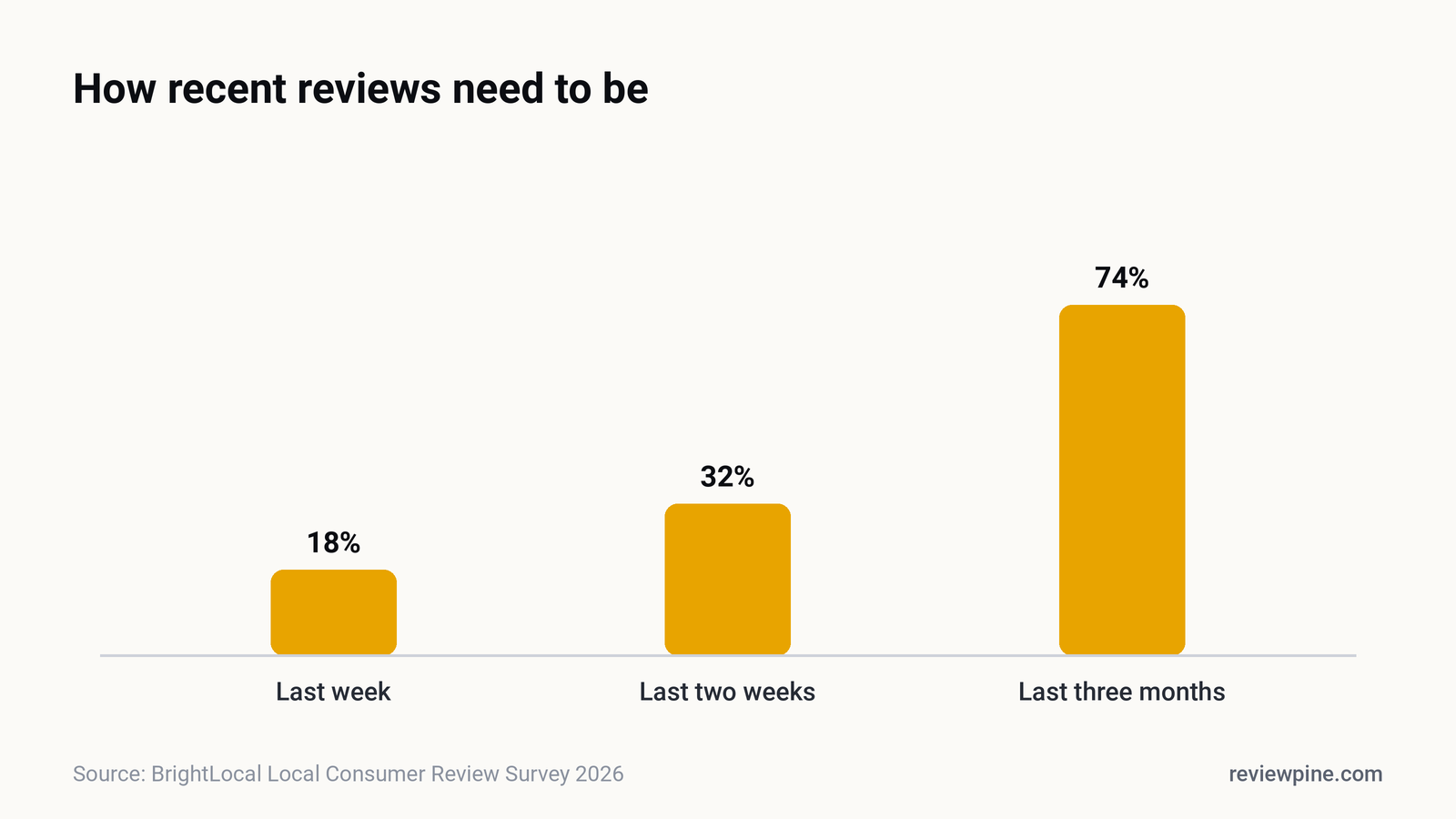
Review recency matters because most buyers judge you on what customers said lately, not what they said years ago. In BrightLocal's 2026 survey, 74% of consumers said they only care about reviews written in the last three months, 32% look for reviews from the last two weeks, and 18% are only swayed by reviews from the last week. A business with 300 reviews but nothing new in six months can look less trustworthy than a competitor with 60 reviews and three from this week.
Here's why freshness carries so much weight, and how to build a steady flow of new reviews without turning it into a campaign.
What does the data say?#
BrightLocal's Local Consumer Review Survey 2026 tracked how recent reviews need to be before consumers take them into account:
| How recent reviews must be | Share of consumers (2026) |
|---|---|
| From the last week | 18% |
| From the last two weeks | 32% (up from 20% in 2025) |
| From the last three months | 74% |
The same survey found that a review having been posted within the last month is one of the top factors that makes it trustworthy (44%), alongside a high star rating (42%). Recency isn't a detail; it's part of how people decide whether a review is believable at all.
Why do old reviews lose their power?#
Businesses change#
Staff move on, owners change, prices rise, services improve or decline. A glowing review from 2023 tells a 2026 customer about a business that may no longer exist in that form. Buyers instinctively know this.
Silence looks like decline#
When the most recent review is months old, readers wonder why customers stopped writing. Fairly or not, a gap reads like a business that's quieter than it used to be.
Competitors' fresh reviews win the comparison#
Buyers usually compare two or three options side by side. A competitor with reviews from last week looks active and current next to you, even if your overall rating is higher.
It may matter for search, too#
Google says review count and score factor into local ranking. It doesn't publish how recency is weighted, but a steady flow of reviews keeps your profile active and gives AI search tools current material. See do Google reviews help SEO? and reviews and AI search.
Is a steady flow better than a big push?#
Yes. Twenty reviews in one week, then nothing for five months, leaves you with a stale profile for most of the year, and a sudden spike can look unnatural to readers. Four reviews a month, every month, keeps you permanently current.
| Pattern | What readers see | Verdict |
|---|---|---|
| Burst of 30, then silence | Fresh for a few weeks, stale for months | Weak |
| One or two a week, steadily | Always current | Strong |
| Nothing new for 6 months | "Are they still open?" | Risky |
How do you keep a steady flow of new reviews?#
Build the request into something that already happens with every customer, so it doesn't depend on anyone remembering:
- Add your review link to automated messages: booking confirmations, invoices, delivery notices, appointment follow-ups.
- Make asking part of the service close: the end of the appointment, the job sign-off, the handover.
- Send a single follow-up two or three days later.
- Set a weekly check: is your newest review less than a week or two old? If not, look at where requests are falling through.
- Reply to every new review, so customers see you're paying attention and are more willing to write.
Our guides to getting more Google reviews and review request templates cover the details.
Tip: Track one simple number each week: the age of your newest review. If it creeps past two weeks, something in your asking routine has broken.
What about seasonal or low-volume businesses?#
If you only see a few clients a month, a review every week isn't realistic, and that's fine. Aim for a review from most clients, and make sure your newest review is never more than a month or two old. Seasonal businesses should ask especially consistently during their busy season, so the profile is current when the next season starts.
What if you have lots of old reviews and few new ones?#
Don't worry about the old ones; they still count towards your total and rating. Focus on restarting the flow:
- Message recent customers from the last month or two who weren't asked.
- Reach out to loyal regulars who've never reviewed you.
- Fix whatever stopped the asking: a staff change, a new booking system, a forgotten email template.
Never try to manufacture recency by buying reviews or asking friends to post. Fake reviews break Google's policies, and in the US the FTC's rule prohibits them. See fake reviews and the law.
Recency for multi-location and franchise businesses#
Each location is judged on its own reviews, so recency needs to be managed per location, not just overall. A busy flagship with daily reviews can hide a quiet branch whose newest review is five months old. Give each location:
- its own direct Google review link and QR code;
- a simple weekly target, such as three new reviews;
- a monthly check of the age of its newest review.
| Location | Reviews | Newest review | Status |
|---|---|---|---|
| Andheri | 214 | 2 days ago | Healthy |
| Bandra | 96 | 9 days ago | Healthy |
| Thane | 38 | 4 months ago | Needs attention |
A table like this, updated monthly, makes it obvious where the asking routine has broken down, usually at a single location after a staff change.
How do you show freshness on your website?#
If your website shows old, hand-copied testimonials, it signals the opposite of what your Google profile now says. Show your newest reviews, with dates, and keep them updating automatically:
| Do | Why |
|---|---|
| Sort reviews on your site by newest | Leads with your most current reputation |
| Show the review date | Freshness is part of credibility |
| Show when reviews were last updated | Tells visitors the reviews are live, not pasted |
| Let new reviews appear automatically | No stale testimonials, no manual work |
ReviewPine refreshes your Google reviews automatically every day on paid plans, can sort them newest first, shows each review's date, and adds a line such as "Reviews on Google as of 29 Sep 2026" so visitors can see the reviews are current.
The bottom line#
Your total review count shows you've been around. Your newest reviews show you're still good. Build asking into every customer interaction, aim for a steady weekly flow, and make sure your website shows your latest reviews rather than your oldest.
Frequently asked questions
Why do recent reviews matter more than old ones?
How often should a business get new Google reviews?
Do old Google reviews still count?
Does review recency affect Google ranking?
How do I get recent reviews quickly?
Turn your Google reviews into your best salesperson
Show real, always-fresh Google reviews on any page of your website, with a "Write a review" button that brings in new ones. Set up in about two minutes.
- Works on WordPress, Shopify, Wix and any site
- Updates itself every day
- No cookies, no slowdown
Anjanee Shukla
Founder, Ainygo Technologies
Anjanee Shukla is the founder of Ainygo Technologies and has been working in the technology industry for over 15 years. He has helped businesses worldwide by developing more than 1,000 websites, web applications, and digital solutions. His expertise spans WordPress, web development, website maintenance, hosting, automation, and business technology. Through this blog, he shares practical advice, technical knowledge, and real-world solutions gained from years of hands-on experience.