Do Google Reviews Help SEO? What Actually Moves Local Rankings
Google says reviews affect local ranking, but not in the way most "review SEO" advice claims. What the evidence supports, what's myth, and the review habits that genuinely help you show up.
On this page
Key takeaways
- Google says review count and review score factor into local search ranking, as part of prominence.
- Google's three local ranking factors are relevance, distance and prominence; reviews are the part of prominence you can grow.
- Recency and a steady flow of reviews matter: 74% of consumers only care about reviews from the last three months (BrightLocal, 2026).
- Don't script reviews or ask for keywords; ask open questions that lead to natural detail.
- Reviews on your own website support conversions but won't give your business star ratings in Google results.
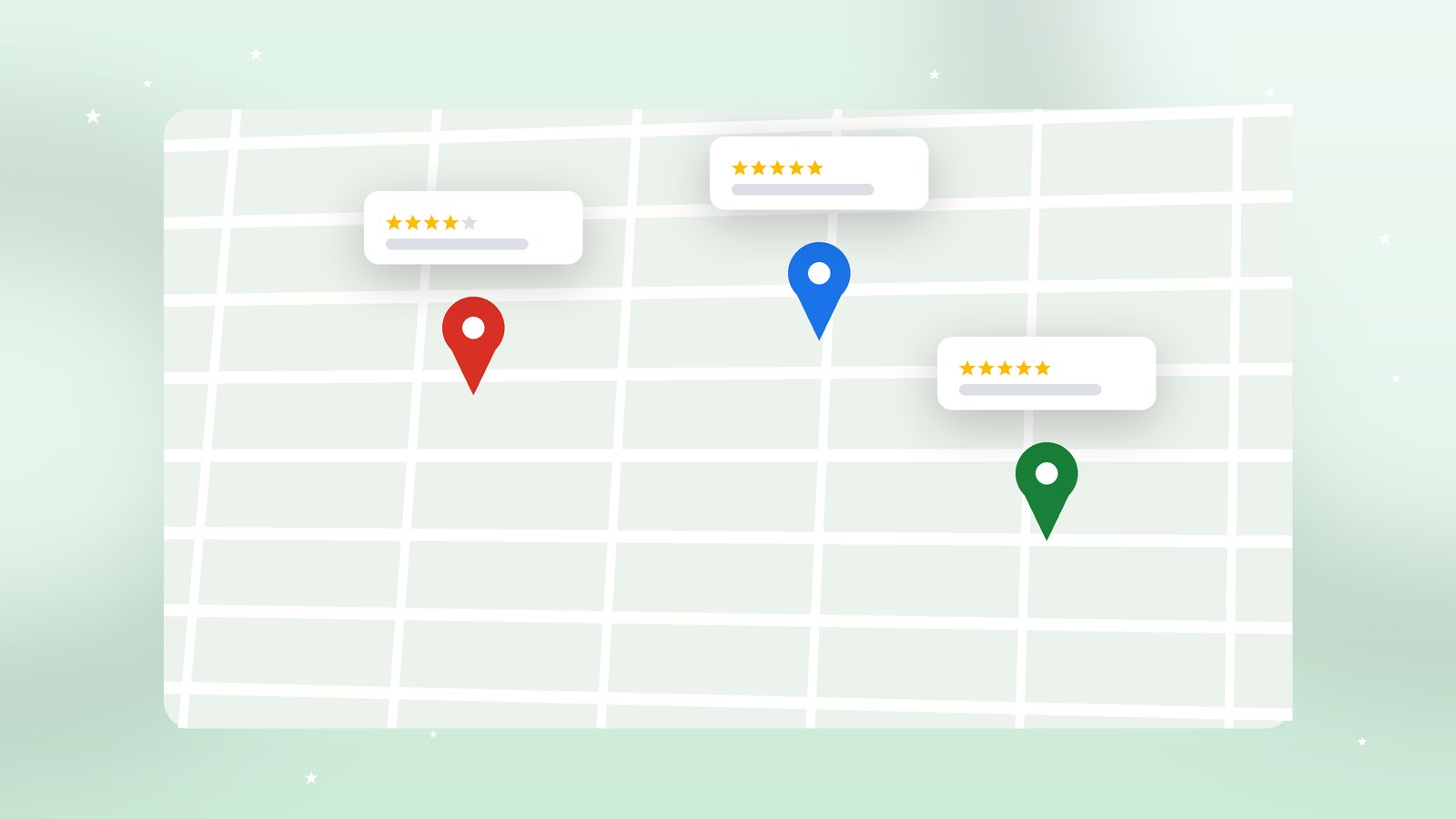
Yes, Google reviews help SEO, mainly local SEO. Google states in its own Business Profile guidance that review count and review score factor into local search ranking, as part of how prominent a business is. Reviews influence whether you appear in the map results for searches like "dentist near me", and they strongly influence whether people click on you when you do.
What reviews don't do is magically lift your website up the ordinary search results, or give your own website star ratings in Google. This guide separates what's supported by Google's own statements from the folklore.
How does Google rank local businesses?#
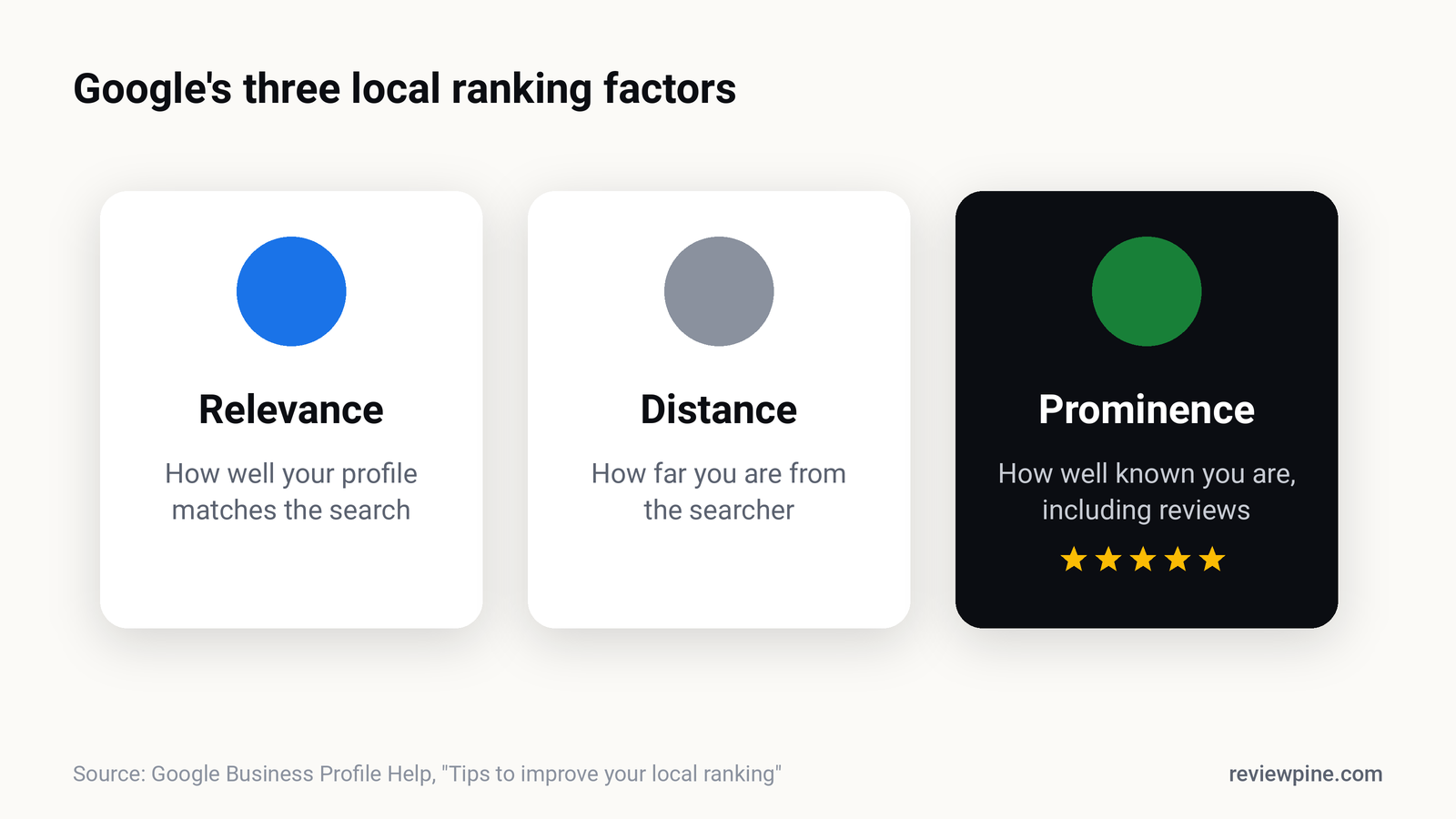
Google describes three main factors for local results:
- Relevance: how well your Business Profile matches what someone searched for.
- Distance: how far you are from the searcher or the location in their search.
- Prominence: how well known your business is, both offline and online. Google says this includes information like links, articles and directories, and how many reviews you have and your rating.
Reviews sit inside prominence. You can't change your distance from a searcher, and relevance mostly comes from your categories and profile details. Prominence is where steady effort pays off, and reviews are the most controllable part of it.
Which aspects of reviews matter?#
Google doesn't publish a formula, so treat anything more precise than "count and score matter" with care. That said, these aspects are consistently supported by Google's guidance, consumer behaviour data and long-running industry studies:
| Aspect | What it means | Why it matters |
|---|---|---|
| Review count | How many reviews you have | Google names it directly; it also signals an established business |
| Average rating | Your star score | Google names it directly; it decides clicks once you're visible |
| Recency | How recent your latest reviews are | Shows you're active now; 74% of consumers ignore reviews older than three months |
| Steady flow | New reviews arriving regularly | A living profile, rather than a burst then silence |
| Review content | What customers write | Mentions of services and places help Google understand what you do |
| Owner replies | Whether you respond | Google encourages it; it builds trust with readers |
Does what customers write in reviews matter?#
It appears to. Google sometimes highlights phrases from reviews that match a search (for example, "mentioned in reviews: gluten free"), which suggests review text helps Google understand what a business offers. That doesn't mean you should script reviews or ask customers to use keywords. Prompting specific wording makes reviews sound fake and goes against the spirit of the platform's rules. Instead, ask open questions that naturally lead to detail: "What did we help you with today?"
Do replies to reviews help ranking?#
Google recommends replying to reviews in its guidance for business owners, and replies clearly help with people. Whether replies directly change ranking is less clear, and Google doesn't say so. Reply because 80% of consumers are more likely to use a business that responds to all reviews (BrightLocal, 2026), and treat any ranking benefit as a bonus.
Do reviews on my website help SEO?#
Indirectly, yes, though less than people claim. Reviews on your site can:
- add fresh, relevant text about your services and location;
- keep visitors on the page longer and increase enquiries, which is the outcome that matters;
- support the topic of a page (a service page with reviews about that service).
Two caveats are worth knowing. First, many review widgets add reviews with JavaScript after the page loads. Google can render JavaScript, but you shouldn't count on widget text as your main page content; write your service pages properly and treat reviews as supporting proof. Second, your own reviews won't produce star ratings in Google's results. Since 2019, Google doesn't show review rich results for local businesses and organisations reviewing themselves on their own sites. See review schema and star ratings for the details.
What's myth?#
| Claim | Reality |
|---|---|
| "Every review boosts your ranking a fixed amount" | Google publishes no formula; count and score are factors among many |
| "Get customers to stuff keywords into reviews" | Scripted reviews look fake and conflict with platform rules |
| "Buying a batch of reviews jumps you up the map" | Fake reviews get removed and can lead to profile restrictions; in the US they can also bring FTC penalties |
| "Review schema on your site gets you stars" | Not for your own business's reviews since 2019 |
| "Only five-star reviews count" | Spiegel research shows buyers trust 4.0 to 4.7 ratings more than a perfect 5.0 |
A practical review plan for local SEO#
- Complete your Business Profile first. Correct categories, services, hours, photos and description do more for relevance than any review tactic.
- Ask every customer for a review, consistently, using your direct review link. Our guide to getting more Google reviews covers how.
- Keep the flow steady. Aim for new reviews every week rather than an occasional push. Review recency explains why freshness matters.
- Reply to every review within a day or two, positive and negative.
- Show reviews on your website near your calls to action, so the traffic reviews help you win actually converts. See where to put reviews on your website.
- Watch AI search too. In 2026, 45% of consumers used AI tools for local recommendations. Rich, recent reviews give those tools something to say about you. More in Google reviews and AI search.
How long does it take for reviews to affect ranking?#
There's no fixed timeline, and anyone promising one is guessing. Local rankings depend on many signals, including your competitors' profiles. What reliably happens is cumulative: businesses that keep collecting and replying to reviews month after month tend to strengthen their prominence, while businesses that stop see their profile age. Think in quarters, not days.
A local SEO checklist that puts reviews in context#
Reviews work best when the rest of your local presence is solid. Before worrying about review tactics, run through this list; each item is something Google either names in its guidance or that directly affects how people respond to your listing.
| Area | What good looks like |
|---|---|
| Business Profile basics | Correct name (no keyword stuffing), primary category that matches your main service, accurate hours including holidays |
| Services and products | Every main service listed, with plain descriptions and prices where sensible |
| Photos | Real photos of your premises, team and work, added regularly |
| Location consistency | Same name, address and phone number on your website, Google and major directories |
| Website | A page for each main service and each location you serve, linked from your profile |
| Reviews | A steady weekly flow, replies to every review, newest review less than two weeks old |
| Questions and updates | Answer common questions in your profile and post occasional updates about offers or news |
What does a realistic quarter look like?#
Example: A two-person accounting firm in Pune starts the quarter with 18 Google reviews, the newest four months old, and appears inconsistently in the map results for "CA near me" in its area. It completes its profile, adds service pages for GST filing and company registration, asks every client for a review after each filing, and replies to all of them. By the end of the quarter it has 41 reviews, the newest from this week, and its listing reads like an active practice. The firm can't control exactly where Google ranks it, but it has strengthened the parts of prominence it can control, and every visitor sees a business that's clearly busy and trusted. The numbers here are illustrative.
What about multi-location businesses?#
Each location needs its own Business Profile, its own review link and its own flow of reviews. Reviews don't pool across locations in local results: a strong flagship branch won't lift a new branch across town. Give each location manager the link and a simple weekly target, and show each location's reviews on its own location page on your website.
The bottom line#
Google reviews help SEO through local prominence, and they help even more at the step after ranking: persuading people to choose you. Focus on a steady flow of genuine reviews, reply to all of them, and make sure the visitors they bring to your website see that same proof when they arrive. ReviewPine shows your real Google reviews on your website, updated automatically, so your hard-won reputation works on every page.
Frequently asked questions
Do Google reviews improve search ranking?
How many Google reviews do I need to rank higher?
Do keywords in Google reviews help SEO?
Does responding to Google reviews help SEO?
Will showing reviews on my website give me stars in Google search?
Turn your Google reviews into your best salesperson
Show real, always-fresh Google reviews on any page of your website, with a "Write a review" button that brings in new ones. Set up in about two minutes.
- Works on WordPress, Shopify, Wix and any site
- Updates itself every day
- No cookies, no slowdown
Anjanee Shukla
Founder, Ainygo Technologies
Anjanee Shukla is the founder of Ainygo Technologies and has been working in the technology industry for over 15 years. He has helped businesses worldwide by developing more than 1,000 websites, web applications, and digital solutions. His expertise spans WordPress, web development, website maintenance, hosting, automation, and business technology. Through this blog, he shares practical advice, technical knowledge, and real-world solutions gained from years of hands-on experience.