Reviews and AI Search: How ChatGPT, Gemini and AI Overviews Pick Local Businesses
45% of consumers now ask AI tools for local recommendations, up from 6% a year earlier. What AI assistants read when they recommend a business, why reviews sit at the centre, and how to give them better material.

On this page
- How fast is AI search growing for local businesses?
- Where do AI assistants get their information about businesses?
- Why do detailed reviews matter more in AI search?
- What can you do to be recommended more often?
- Does the recency of reviews matter for AI?
- What about AI-generated review summaries?
- Can you trick AI search with fake reviews?
- How can you check what AI assistants say about you?
- The bottom line
Key takeaways
- 45% of consumers used ChatGPT or other AI tools for local recommendations in 2026, up from 6% (BrightLocal).
- 82% of consumers read AI-generated review summaries, and 23% would rely on them alone.
- AI assistants draw on business listings, review platforms, websites and third-party mentions.
- Detailed reviews give AI systems specific things to say; ask open questions rather than requesting keywords.
- Consistent business details, a clear website and a steady flow of recent reviews are the practical levers.
- Fake reviews, including AI-generated ones, break platform rules and, in the US, the FTC rule.
AI assistants such as ChatGPT, Gemini and Google's AI Overviews recommend local businesses by summarising what they can find about them across the web, and customer reviews are one of the richest sources they draw on. In BrightLocal's 2026 survey, 45% of consumers had used ChatGPT or another AI tool to find local business recommendations, up from just 6% a year earlier. Businesses with many detailed, recent reviews give these tools far more to work with than businesses with a handful of old ones.
Nobody outside the AI companies knows exactly how each system weighs its sources, and anyone promising guaranteed AI rankings is overselling. But the direction is clear enough to act on.
How fast is AI search growing for local businesses?#
Faster than almost any shift in local search before it. BrightLocal's Local Consumer Review Survey 2026 found:
| Finding (2026) | Share |
|---|---|
| Used ChatGPT or other AI tools for local recommendations | 45% (up from 6%) |
| Trust AI platforms to provide business recommendations | 40% |
| Trust AI recommendations as much as traditional reviews | 42% |
| Read AI-generated review summaries | 82% |
| Would rely only on an AI review summary to decide | 23% |
| Used Google to find local business reviews | 71% (down from 83%) |
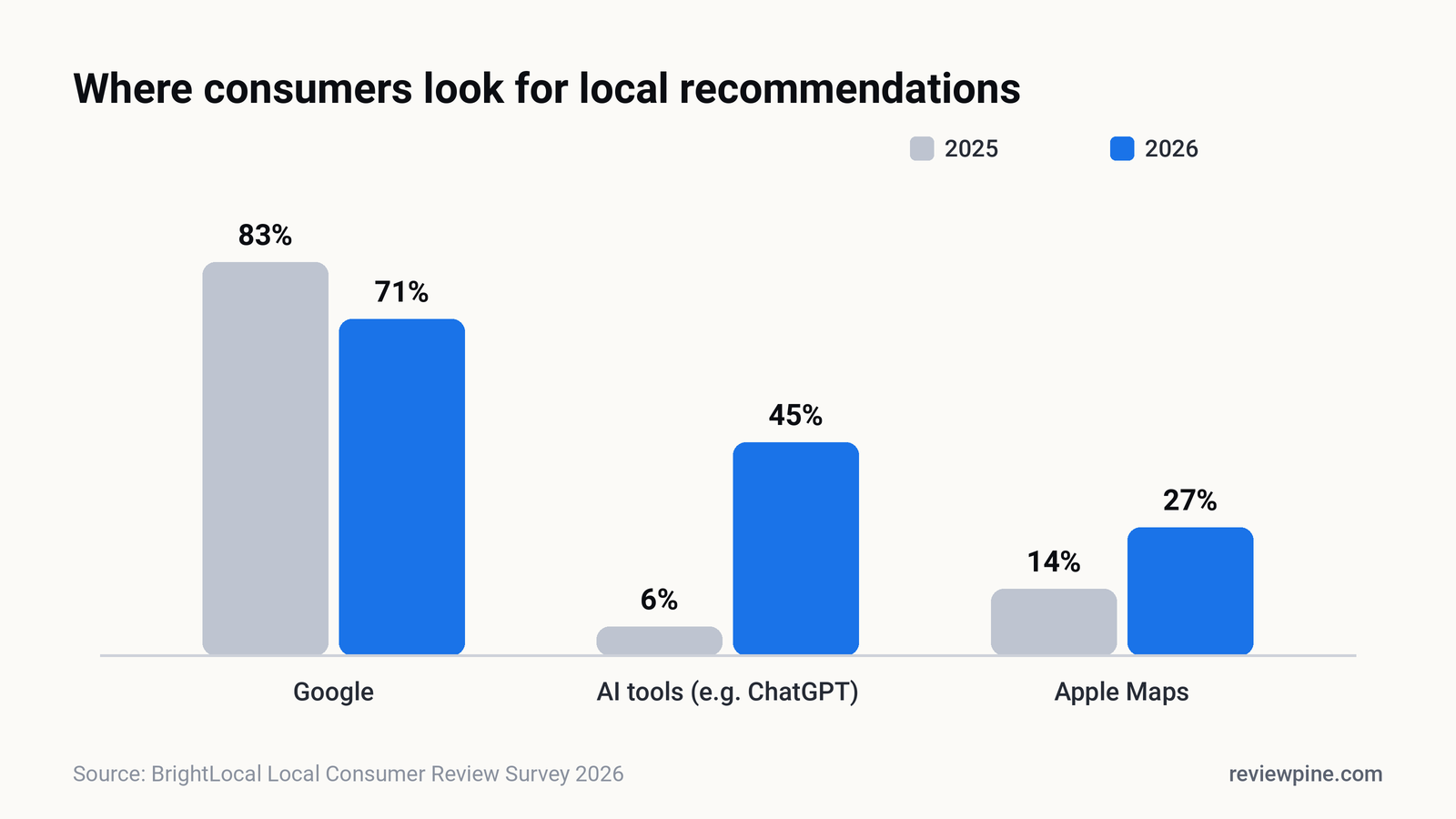
Google is still the biggest single source, but it's no longer the only one that matters. And even inside Google, AI is increasingly the first thing people read: review summaries above individual reviews, and AI Overviews above search results.
Where do AI assistants get their information about businesses?#
Each system differs, but they generally draw on some combination of:
- Business listings: Google Business Profile, Apple Maps, Bing Places and similar directories.
- Review platforms: Google reviews, Tripadvisor, Yelp, Facebook and industry sites.
- Your website: what you do, where, for whom, and at what price.
- Third-party mentions: local news, "best of" lists, industry directories and forums.
- Search indexes that some assistants query live when answering.
Reviews matter because they're the main place where independent people describe what a business is actually like, in their own words. When someone asks an AI "which dentist near Koramangala is good with nervous patients?", the assistant can only connect your clinic to "nervous patients" if someone has written about it.
Why do detailed reviews matter more in AI search?#
Traditional search mostly needed your rating and count. AI search reads the words. A review that says "Dr. Rao explained every step and I wasn't anxious at all" gives an AI assistant something specific to repeat. A review that says "Good" gives it nothing.
That changes what to ask for. Not keywords, which make reviews sound scripted and conflict with platform rules, but detail. Open questions do this naturally:
- "What did we help you with today?"
- "What would you tell a friend who's thinking of coming to us?"
Our review request templates include versions that invite natural detail.
What can you do to be recommended more often?#
There's no switch to flip, but these steps give AI systems clearer, richer and more consistent information:
- Collect a steady flow of detailed reviews on Google and one or two platforms important in your industry. See how to get more Google reviews.
- Keep business details identical everywhere. Name, address, phone, hours and categories should match across your Business Profile, website and directories. Conflicting details create doubt.
- Write a clear, factual website. Say plainly what you do, where, for whom and at what price. Answer common questions directly in the first sentence of each section, so a system can quote you accurately.
- Add organisation details in structured data (name, logo, address, contact), so machines can identify your business reliably. Skip self-serving review markup; see review schema and star ratings.
- Reply to reviews thoughtfully. Replies add context: "we've since added weekend appointments" is information an assistant may pick up.
- Earn mentions on trusted local sites: local press, chambers of commerce, community groups and industry associations.
- Show your reviews on your website. Visitors who arrive from an AI recommendation still check your site, and seeing the same praise there confirms the recommendation. See where to put reviews on your website.
Does the recency of reviews matter for AI?#
It matters for people, and it's reasonable to assume it matters for systems trying to give current answers. BrightLocal found 74% of consumers only care about reviews from the last three months. An AI summary built on reviews that are two years old describes a business that may no longer exist in that form. Keep new reviews coming; more in review recency.
What about AI-generated review summaries?#
Google, Amazon and others now show AI summaries above individual reviews, and 82% of consumers read them. You can't edit these summaries directly. What you can do is shape the underlying material: if most recent reviews mention fast service and friendly staff, that's what summaries tend to reflect. If one complaint keeps recurring, fixing the underlying problem is the only real lever.
Can you trick AI search with fake reviews?#
No, and trying is dangerous. AI systems draw on platforms that actively remove fake reviews, and fake reviews break Google's policies everywhere. In the US, the FTC's rule in force since October 2024 explicitly covers AI-generated fake reviews. Beyond the legal risk, an assistant that surfaces your business on the back of fake praise sends customers who'll be disappointed, and they'll say so. See fake reviews and the law.
How can you check what AI assistants say about you?#
You can't see inside the systems, but you can ask them, the way your customers do. Once a month, try a few prompts in the assistants your customers are likely to use:
- "Recommend a [your service] in [your area]."
- "Is [your business name] in [your area] any good?"
- "What do customers say about [your business name]?"
Note whether you're mentioned, what's said, and which sources are cited, where the assistant shows them. If an answer is wrong or out of date, the fix is usually upstream: update your Business Profile, correct inconsistent directory listings, clarify the relevant page on your website, and keep collecting detailed reviews about the services you want to be known for.
| What you find | Likely cause | What to do |
|---|---|---|
| Not mentioned at all | Thin or inconsistent information about you | Complete your profile, build reviews, earn local mentions |
| Outdated details (hours, services) | Old listings or pages | Update every listing and your website |
| Vague praise only | Short, generic reviews | Ask open questions that invite detail |
| A recurring complaint | A real pattern in reviews | Fix the problem; reply explaining the fix |
The bottom line#
AI search doesn't replace the fundamentals; it raises the stakes on them. Detailed, recent, genuine reviews, consistent business information and a clear website are what give AI assistants something accurate and positive to say about you. And when those recommendations send people to your website, ReviewPine makes sure they see the same real Google reviews there, confirming the recommendation at the moment they decide.
Frequently asked questions
How does ChatGPT recommend local businesses?
Do Google reviews affect AI search results?
How can I get my business recommended by AI tools?
Should I ask customers to mention keywords in reviews for AI search?
Is AI search replacing Google for local businesses?
Turn your Google reviews into your best salesperson
Show real, always-fresh Google reviews on any page of your website, with a "Write a review" button that brings in new ones. Set up in about two minutes.
- Works on WordPress, Shopify, Wix and any site
- Updates itself every day
- No cookies, no slowdown
Anjanee Shukla
Founder, Ainygo Technologies
Anjanee Shukla is the founder of Ainygo Technologies and has been working in the technology industry for over 15 years. He has helped businesses worldwide by developing more than 1,000 websites, web applications, and digital solutions. His expertise spans WordPress, web development, website maintenance, hosting, automation, and business technology. Through this blog, he shares practical advice, technical knowledge, and real-world solutions gained from years of hands-on experience.