Why Online Reviews Matter: The 2026 Guide for Small Businesses
Reviews now decide who gets the call, the booking or the sale. What the latest research says, why it matters more each year, and what to do about it this week.

On this page
- What is an online review, and why does it carry so much weight?
- What does the 2026 research actually say?
- Do reviews really affect sales, or just opinions?
- How do reviews help people find you in the first place?
- Why are negative reviews not the disaster they feel like?
- Which review platforms matter most?
- Why should reviews also live on your own website?
- How do you get more reviews without breaking the rules?
- A simple 30-day review plan
- The bottom line
Key takeaways
- 97% of consumers read reviews when choosing a local business (BrightLocal, 2026).
- A one-star rise in rating was linked to a 5 to 9% revenue increase for independent restaurants (Harvard Business School).
- Products with five reviews were 270% more likely to be bought than products with none (Spiegel Research Center).
- Google says review count and score factor into local search ranking.
- 74% of people only care about reviews from the last three months, so a steady flow matters more than a big total.
- Ask every customer, never pay for reviews, reply to all of them, and show them on your own website.
Online reviews matter because they have become the main way people decide whether to trust a business they have never used. In BrightLocal's 2026 survey, 97% of consumers said they read reviews when choosing a local business, 85% were more likely to use one after reading positive reviews, and 77% were put off by negative ones. Reviews shape who gets found, who gets shortlisted and who gets paid.
That's the short answer. The longer one is more useful, because "reviews matter" is the kind of advice everyone nods at and nobody acts on. This guide covers what has actually changed, which numbers deserve your attention, and a plan you can start this week without hiring anyone.
What is an online review, and why does it carry so much weight?#
An online review is a public rating and written comment left by a customer on a platform such as Google, Facebook, Tripadvisor or an industry directory. What gives it weight is who wrote it. Your website copy is you talking about yourself. A review is a stranger with no reason to flatter you, telling other strangers what happened.
That independence is the whole point. People discount advertising because it's paid for. They don't discount a neighbour's story about the plumber who turned up on time, fixed the leak and charged what he quoted. Reviews are that neighbour, multiplied by fifty and available at 11pm.
What does the 2026 research actually say?#
BrightLocal has run its Local Consumer Review Survey every year since 2010, which makes it the longest-running dataset on how people use reviews for local businesses. The 2026 edition is worth reading in full, but these are the findings that matter most to a business owner:
| Finding (BrightLocal, 2026) | Share of consumers |
|---|---|
| Read reviews when choosing a local business | 97% |
| "Always" read reviews when browsing | 41% (up from 29%) |
| More likely to use a business after positive reviews | 85% |
| Less likely to use a business after negative reviews | 77% |
| Won't use a business with fewer than 20 reviews | 47% |
| Only care about reviews from the last three months | 74% |
| Will only use businesses rated 4 stars or more | 68% (up from 55%) |
| More likely to use a business that replies to all reviews | 80% |
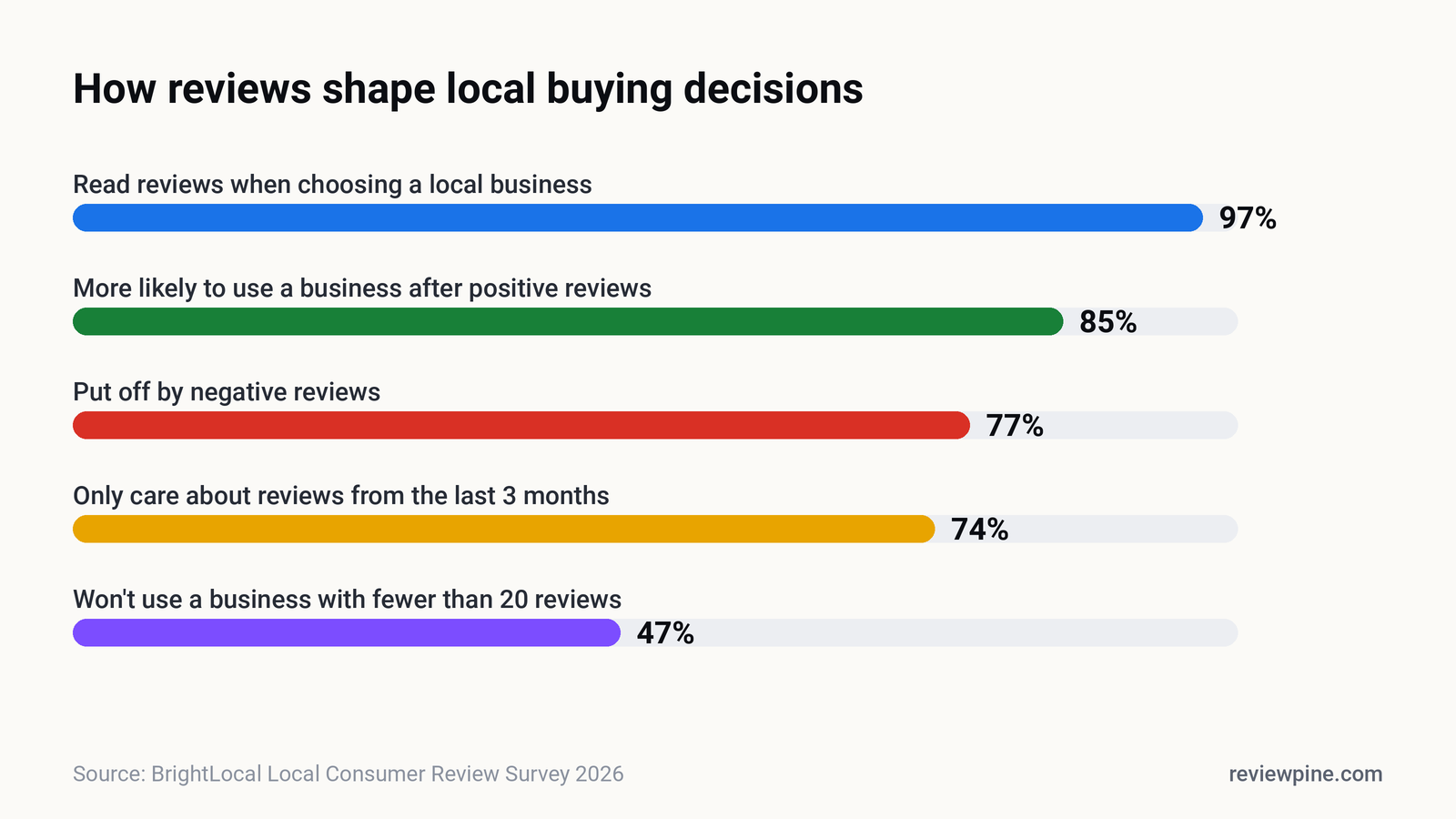
Two things stand out. First, expectations are rising fast. The share of people who need at least four stars jumped thirteen points in a single year, and the share who need 4.5 stars nearly doubled, from 17% to 31%. Second, freshness now matters almost as much as the score. A 4.8 rating built from reviews that are two years old reads like a business that used to be good.
Do reviews really affect sales, or just opinions?#
They affect money, and the strongest evidence comes from academic research rather than marketing surveys.
A widely cited Harvard Business School working paper by Michael Luca combined Yelp ratings with restaurant revenue data from Washington State. It found that a one-star increase in a restaurant's rating led to a 5 to 9 percent increase in revenue. The effect was concentrated in independent restaurants. Chains, which people already know, barely moved. That pattern is the important part for small businesses: reviews do the most work for the businesses customers have never heard of.
On the purchase side, Northwestern University's Spiegel Research Center analysed millions of product page visits and found that a product with five reviews was 270% more likely to be bought than one with none. The jump was even bigger for higher-priced items, which makes sense: the more a decision costs, the more reassurance people look for before they commit.
BrightLocal's 2026 survey adds the consumer's view of the same thing: 93% of people say they have made a purchase after reading reviews, and 27% have spent more than $1,000 that way.
Key point: Reviews matter most when the buyer can't easily judge quality in advance. That describes almost every local service, from dentists and salons to contractors, coaching centres and clinics.
How do reviews help people find you in the first place?#
Reviews don't only convince people who have already found you. They also help decide whether you get found at all.
Google says plainly, in its guidance on local ranking, that review count and review score factor into local search ranking, as part of how prominent a business is. More reviews and better ratings can improve where you appear in the map results that show up for "near me" searches.
Discovery is also spreading beyond Google. In the 2026 BrightLocal survey, 45% of consumers said they had used ChatGPT or another AI tool to find local business recommendations, up from 6% a year earlier. Those tools lean heavily on what customers have written about a business across the web. A business with few, old or thin reviews gives an AI assistant very little to say. We cover this in more depth in how reviews influence AI search recommendations.
Why are negative reviews not the disaster they feel like?#
Because a page of perfect scores isn't trusted either. Spiegel's research found that purchase likelihood peaks for ratings between roughly 4.0 and 4.7, then starts to fall as ratings approach a perfect 5.0. Shoppers read a flawless record as too good to be true.
A few honest three-star reviews, answered calmly and specifically, do two jobs. They prove the five-star reviews are real, and they show a prospective customer how you behave when something goes wrong. That second job is often the one that wins the sale. Our guide to responding to negative reviews walks through exactly how to write those replies.
What does hurt is silence. BrightLocal found that 42% of consumers are unlikely to use a business that ignores its reviews entirely.
Which review platforms matter most?#
For most local businesses, Google is still the platform that matters most, by a wide margin. It's where most people read reviews, it feeds Maps and local search, and in the 2026 survey it was where 45% of consumers had written a review in the past year, ahead of Facebook at 34%.
That doesn't mean ignoring everything else. Industry platforms carry real weight in their niches: Tripadvisor for hospitality, Practo for doctors in India, Zomato for restaurants, Houzz for home improvement. A sensible approach is to treat Google as the main channel, keep one industry-specific platform healthy, and make sure your Facebook page isn't quietly collecting complaints nobody answers.
| Platform | Why it matters | Best for |
|---|---|---|
| Feeds Maps, local search and many AI answers | Almost every local business | |
| Large audience, recommendations from friends | Consumer services, restaurants, retail | |
| Industry sites | High intent, trusted within the niche | Healthcare, hospitality, home services |
| Your own website | Where the buying decision is made | Converting visitors you already attracted |
Why should reviews also live on your own website?#
Here's the gap most businesses never close. Someone finds you on Google, reads a few reviews, then clicks through to your website to check prices or book. BrightLocal found that 54% of consumers visit a business's website after reading positive reviews. And on most websites, the reviews disappear at exactly that moment.
Your website is where the decision gets made, and it's usually the least convincing page in the whole journey: your own claims, a stock photo and a contact form. Putting real Google reviews on that page, close to the button you want people to press, carries the trust they just felt on Google into the place where they act. We explain the options in how to add Google reviews to your website.
How do you get more reviews without breaking the rules?#
You ask. That sounds too simple, but it's the most reliable tactic there is. In the 2026 survey, 78% of consumers had been asked for a review in the past year, and 83% of the people who were asked went on to leave one.
The rules are just as simple:
- Ask everyone, not just the happy ones. Google's policies prohibit selectively asking for positive reviews, a practice known as review gating.
- Never pay or reward people for reviews. Discounts, freebies and lucky draws in exchange for reviews break Google's policies, and in the US they can breach the FTC's rule on fake and incentivised reviews.
- Never write reviews yourself or let staff and family do it. Platforms detect it, and the reputational damage outlasts any short-term boost.
- Make it effortless. Send the direct link to your Google review form, at the moment the customer is happiest.
The full playbook, including timing and wording, is in how to get more Google reviews, and you'll find ready-to-send messages in our review request templates.
A simple 30-day review plan#
If you do nothing else after reading this, do this:
| Week | What to do |
|---|---|
| Week 1 | Claim and complete your Google Business Profile. Copy your review link. Reply to every review you've ever received that hasn't had a reply. |
| Week 2 | Add a review request to your normal process: the end of an appointment, the delivery message, the invoice email. Ask every customer. |
| Week 3 | Put your real Google reviews on your homepage and on the page where people contact or book you. |
| Week 4 | Set a weekly 15-minute slot to reply to new reviews. Check that your newest review is less than a month old. |
None of this needs a big budget. It needs a habit. The businesses with the strongest review profiles rarely did anything clever. They just asked consistently, replied every time, and showed the results where buyers could see them.
The bottom line#
Online reviews are no longer a nice extra on top of marketing. For a local business, they are a large share of the marketing: they decide whether you appear, whether you're trusted and, increasingly, whether an AI assistant mentions you at all. The good news is that the work is simple and cheap. Ask every customer, answer every review, keep them fresh, and put them where buyers make up their minds.
If you'd like the last step handled for you, ReviewPine shows your real Google reviews on any website with one line of code, keeps them up to date by itself, and adds a "Write a review" button that sends happy customers straight to your Google review form.
Frequently asked questions
Why are online reviews important for a small business?
How many online reviews does a business need?
Do negative reviews hurt a business?
Is it legal to pay for reviews?
Should I put reviews on my own website?
Turn your Google reviews into your best salesperson
Show real, always-fresh Google reviews on any page of your website, with a "Write a review" button that brings in new ones. Set up in about two minutes.
- Works on WordPress, Shopify, Wix and any site
- Updates itself every day
- No cookies, no slowdown
Anjanee Shukla
Founder, Ainygo Technologies
Anjanee Shukla is the founder of Ainygo Technologies and has been working in the technology industry for over 15 years. He has helped businesses worldwide by developing more than 1,000 websites, web applications, and digital solutions. His expertise spans WordPress, web development, website maintenance, hosting, automation, and business technology. Through this blog, he shares practical advice, technical knowledge, and real-world solutions gained from years of hands-on experience.